Short answer: Shopify Hydrogen can be an excellent choice for brands that need a highly customized, scalable and performance-focused Shopify storefront, but it is not automatically better than a traditional Shopify theme. The right choice depends on your storefront complexity, performance requirements, SEO strategy, integrations, development resources and long-term maintenance needs.
In 2026, the Shopify headless ecosystem has also evolved significantly. Hydrogen is no longer something you should evaluate only as a frontend framework. Shopify’s current ecosystem includes the Storefront API, Hydrogen, React Router, Oxygen, custom storefront tooling and newer framework-agnostic capabilities designed for modern web and AI-powered commerce.
This guide explains what Shopify Hydrogen is, how headless Shopify architecture works, how Hydrogen compares with Shopify Liquid and Next.js, what it means for SEO and AI commerce, what it can cost, and when a business should — or should not — invest in a headless Shopify storefront.
Key Takeaways
- Shopify Hydrogen is designed for headless commerce and provides Shopify-specific tools for building custom storefronts.
- The Shopify Storefront API is the commerce data layer connecting Shopify’s backend capabilities to custom customer experiences.
- Current Hydrogen is built on React Router, while Shopify’s 2026 developer preview is moving toward a framework-agnostic toolkit.
- Headless does not automatically mean faster. Performance depends on architecture, caching, rendering, images, JavaScript and engineering quality.
- Headless does not automatically improve SEO. SEO must be intentionally engineered into the storefront.
- Hydrogen can be valuable for complex Shopify stores that need highly customized UX, integrations, personalization or application-like shopping experiences.
- Many stores do not need headless. A well-built Shopify Liquid theme can remain the more practical solution for simpler requirements.
- AI commerce is becoming part of the headless conversation, with Shopify adding tooling for AI agents and machine-mediated shopping experiences.
What Is Shopify Hydrogen?
Shopify Hydrogen is Shopify’s technology stack for building custom headless commerce experiences. It provides Shopify-specific components, utilities and tools that help developers build storefronts using Shopify’s commerce infrastructure while having much greater control over the customer-facing frontend.
In a traditional Shopify theme, Shopify controls much of the relationship between the storefront presentation and the commerce platform through Liquid and the Online Store architecture.
With a headless Shopify storefront, the customer-facing frontend is separated from the traditional Shopify theme layer. The frontend communicates with Shopify through APIs such as the Storefront API.
This architecture allows a business to keep Shopify’s commerce capabilities while creating a much more customized digital experience.
In simple terms, what does Shopify Hydrogen do?
Think of Shopify as the commerce engine and Hydrogen as a toolkit for building the custom experience customers interact with.
Shopify can continue handling commerce operations such as products, collections, inventory, cart and checkout, while your development team controls how the storefront is designed, rendered and integrated with other systems.
What Is Shopify Headless Commerce?
Shopify headless commerce is an architecture where the customer-facing storefront is separated from Shopify’s traditional theme presentation layer while Shopify continues to provide commerce infrastructure.
This separation allows developers to create custom web experiences using technologies and frameworks that are better suited to the project’s requirements.
The Shopify Storefront API is a foundational part of this architecture. Shopify describes it as the API layer for building custom and scalable shopping experiences across web, mobile, games and other customer touchpoints.
Traditional Shopify architecture
Shopify backend → Shopify theme → Customer
Headless Shopify architecture
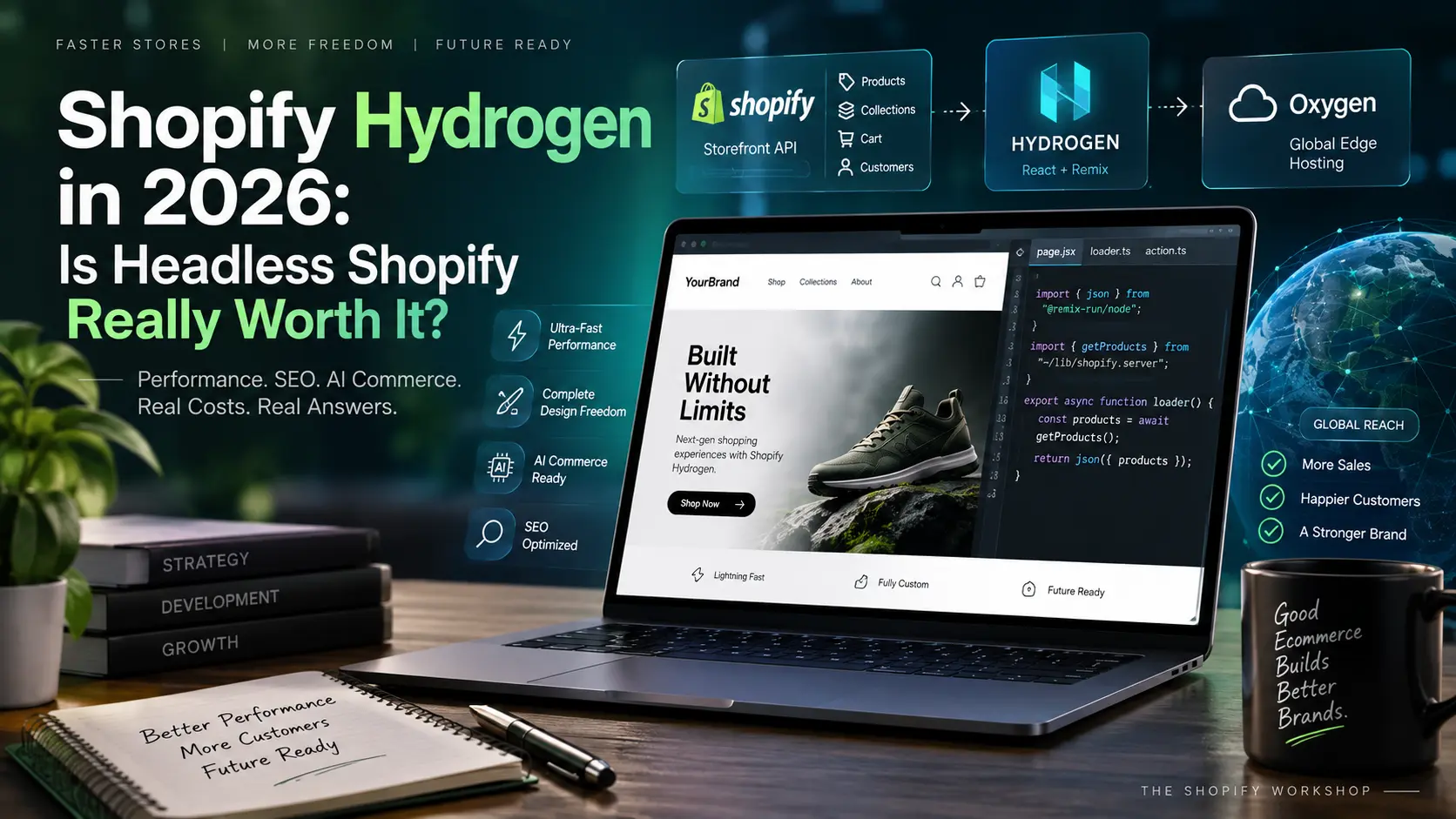
Shopify commerce backend → Storefront API → Custom frontend → Customer
The headless model introduces significantly more flexibility, but it also introduces additional engineering responsibility.
How Does Shopify Hydrogen Architecture Work?
A professional Shopify Hydrogen implementation can be understood as several interconnected layers.
1. Shopify Commerce Backend
Shopify remains responsible for core commerce functionality including products, variants, collections, inventory, pricing, discounts, orders and checkout-related functionality.
2. Shopify Storefront API
The Storefront API provides the commerce primitives needed by the custom storefront. It can provide access to products, collections, search, pages, blogs, articles, cart functionality and other storefront capabilities depending on authentication and API permissions.
3. Hydrogen and React
Hydrogen provides Shopify-specific components, utilities and commerce tooling for building custom storefront experiences. Current Shopify documentation describes Hydrogen as an opinionated headless commerce stack built on React Router.
4. React Router and Rendering
React Router handles important application concerns such as routing, data loading and server-side rendering within the current Hydrogen architecture.
5. Oxygen and Edge Hosting
Oxygen is Shopify’s global edge hosting platform designed for Hydrogen storefronts. It provides an integrated deployment option for businesses that want their headless storefront closely aligned with Shopify’s ecosystem.
6. Customer Experience
The final layer is the storefront customers actually interact with — including product pages, collection pages, navigation, search, cart, personalization, content, checkout transitions and other custom experiences.
Is Shopify Hydrogen Still Based on Remix in 2026?
The answer requires some context.
Hydrogen became closely associated with Remix, and Shopify’s existing documentation still contains Remix-related concepts. However, the current Hydrogen documentation identifies React Router as the framework Hydrogen is built on.
More importantly, Shopify introduced a Hydrogen developer preview in June 2026 that moves the architecture toward a framework-agnostic toolkit. Shopify describes this new direction as a toolkit rather than a framework, allowing Shopify commerce primitives to work with the framework and JavaScript runtime chosen by the development team.
Therefore, businesses planning a new headless Shopify project in 2026 should evaluate the current Hydrogen ecosystem and architecture rather than relying on older articles that describe Hydrogen simply as “Shopify’s Remix framework.”
Shopify Hydrogen vs Shopify Liquid: Which Is Better?
Neither architecture is universally better. The correct choice depends on what your business actually needs.
| Requirement | Shopify Liquid | Headless / Hydrogen |
|---|---|---|
| Fast initial launch | Strong fit | Usually more development required |
| Merchant-controlled theme editing | Strong fit | More developer involvement |
| Highly custom frontend | Can become limiting | Strong fit |
| Complex interactive experiences | Possible but constrained | Strong fit |
| Advanced application-style UX | More difficult | Strong fit |
| Lower technical complexity | Strong fit | Higher complexity |
| Ongoing frontend development | Lower requirement | Higher requirement |
Choose Shopify Liquid when…
- Your existing storefront already meets your UX requirements.
- You want merchants to make frequent visual changes without developers.
- Your primary goal is a fast and cost-efficient launch.
- Your custom requirements can be solved through theme development.
- You do not have dedicated frontend engineering resources.
Consider Hydrogen or another headless architecture when…
- Your customer experience is highly customized.
- You require application-like shopping experiences.
- You have complex product configuration requirements.
- You need deep integrations with external platforms.
- You need advanced personalization or custom discovery.
- You have an experienced React or JavaScript development team.
- You are building multiple customer-facing experiences around Shopify.
Does Shopify Hydrogen Improve Website Performance?
Hydrogen can provide a strong foundation for high-performance storefronts, but the framework itself does not guarantee a fast website.
Performance depends on implementation quality.
A professional Hydrogen storefront should consider:
- Server-side rendering
- Edge delivery
- Storefront API caching
- Optimized GraphQL queries
- Image optimization
- Code splitting
- Lazy loading
- Minimal client-side JavaScript
- Third-party script management
- Core Web Vitals
Shopify’s 2026 Hydrogen developer preview also introduced Storefront API caching for catalog data, allowing products, collections and pages to be cached at the edge in supported environments.
The important distinction is:
Hydrogen gives developers performance tools and architectural flexibility. Engineering discipline determines whether the final store is actually fast.
Does Shopify Hydrogen Help SEO?
Yes, a properly engineered Hydrogen storefront can be SEO-friendly. However, headless architecture does not automatically improve search rankings.
SEO needs to be implemented at the application and content architecture level.
Important Shopify Hydrogen SEO requirements
- Server-rendered HTML
- Unique title tags
- Unique meta descriptions
- Canonical URLs
- XML sitemap
- Robots.txt
- Product structured data
- Breadcrumb structured data
- Open Graph metadata
- Correct heading hierarchy
- Internal linking
- SEO-friendly URLs
- Optimized images
- Core Web Vitals
- Proper redirects during migration
Shopify’s Hydrogen SEO documentation specifically covers metadata, sitemap.xml and robots.txt implementation, including the getSeoMeta utility for rendering SEO metadata.
Shopify Hydrogen and AI Search: Why This Matters in 2026
AI-powered commerce is changing how customers discover products.
Traditional search depends heavily on users entering queries into a search engine and selecting a webpage. AI-powered shopping experiences can instead summarize products, compare options, answer product questions and increasingly interact with commerce systems.
Shopify has been adding infrastructure around this shift. Its Hydrogen ecosystem now includes tooling related to in-browser AI agents, and Shopify has also introduced capabilities intended to support agentic commerce.
For ecommerce brands, this creates a broader visibility question:
Can your product information be understood and accessed by both human shoppers and machine-driven shopping experiences?
This is why structured product information, clean commerce data, strong metadata, accessible content and well-designed APIs are becoming increasingly important.
What Is the Shopify Storefront API?
The Shopify Storefront API is Shopify’s GraphQL API for building custom storefront experiences.
It provides access to commerce capabilities such as products, collections, search, cart functionality and other storefront data.
The Storefront API is important because it allows a custom frontend to communicate with Shopify’s commerce platform without depending entirely on Shopify’s traditional Liquid theme rendering system.
Developers can use the Storefront API with Hydrogen, Next.js, Vue and other frameworks or platforms.
Hydrogen vs Next.js for Shopify Headless Development
Hydrogen and Next.js are not simply competing products. They represent different architectural approaches and can both be used in Shopify headless projects.
Hydrogen
Hydrogen is specifically designed around Shopify commerce and provides Shopify-focused components, utilities and tooling.
Next.js
Next.js provides a broader React application framework and can be useful when Shopify is part of a larger digital platform containing multiple APIs, services or content systems.
Which should your business choose?
The answer depends on your existing technology stack, development expertise, hosting requirements, integrations and long-term architecture.
In 2026, the decision is becoming even more flexible because Shopify’s Hydrogen developer preview is designed to separate Shopify’s commerce primitives from the frontend framework itself.
Is Shopify Hydrogen Suitable for Shopify Plus?
Shopify Plus and headless commerce solve different problems.
Shopify Plus provides advanced commerce capabilities and enterprise-oriented Shopify features. Headless development changes how the storefront experience is built.
A Shopify Plus merchant can use a traditional storefront architecture or adopt a headless architecture when the business requirements justify it.
Therefore, being on Shopify Plus does not automatically mean a business should go headless.
How Much Does Shopify Hydrogen Development Cost?
There is no universal Shopify Hydrogen development price because project complexity varies dramatically.
A headless project may involve architecture, UX design, frontend development, Storefront API integration, CMS integration, search, customer accounts, analytics, SEO, performance engineering, migration and ongoing maintenance.
For that reason, comparing the cost of a custom Hydrogen storefront with the cost of installing a Shopify theme is not an apples-to-apples comparison.
Factors that affect headless Shopify development cost
- Number and complexity of templates
- Custom product experiences
- Product configurators
- Third-party integrations
- CMS requirements
- Search and filtering
- Customer account functionality
- Personalization
- Internationalization
- SEO migration
- Performance requirements
- Analytics and tracking
- Ongoing maintenance
What Are the Disadvantages of Shopify Hydrogen?
The biggest disadvantage of headless Shopify is additional technical complexity.
Before choosing Hydrogen, a business should understand the trade-offs.
- Higher initial development requirements
- Greater dependency on frontend developers
- More complex deployment architecture
- More responsibility for SEO implementation
- More custom code to maintain
- Potentially higher long-term development costs
- More technical responsibility for storefront changes
Headless is therefore best viewed as a strategic architecture decision rather than a simple Shopify upgrade.
What Happens to SEO During a Shopify Headless Migration?
SEO migration is one of the highest-priority technical workstreams when replacing an existing Shopify storefront with a headless frontend.
Before launch, create a complete mapping of existing URLs and their new destinations.
Important migration checks
- Product URLs
- Collection URLs
- Blog URLs
- Landing pages
- Canonical URLs
- 301 redirects
- Internal links
- XML sitemap
- Robots.txt
- Metadata
- Structured data
A technically impressive new storefront can still create organic traffic problems if URL changes and redirects are not handled correctly.
Who Should Consider Shopify Hydrogen?
Shopify Hydrogen is most relevant to businesses where the storefront experience itself is strategically important.
Typical examples include:
- Fast-growing ecommerce brands
- Enterprise Shopify merchants
- Shopify Plus businesses
- Brands with complex product configuration
- Businesses requiring custom customer journeys
- Omnichannel commerce platforms
- Brands integrating multiple backend systems
- Companies with experienced frontend development teams
Who Probably Does Not Need Headless Shopify?
A business probably does not need a headless architecture simply because headless is technically impressive.
If your Shopify theme already provides the required customer experience, performs well and can be efficiently managed by your team, rebuilding the storefront may add unnecessary complexity.
In many cases, investing in better theme development, CRO, performance optimization, SEO and conversion strategy can create more value than rebuilding the entire frontend.
How to Decide If Your Shopify Store Needs Headless
Use these questions before approving a headless Shopify project:
- What specific business problem will headless solve?
- Can the same problem be solved with a custom Shopify theme?
- Does the customer experience require technology beyond Liquid?
- Do we have developers capable of maintaining the frontend?
- What is our three-year maintenance plan?
- How will SEO be preserved during migration?
- How will performance be measured?
- Which APIs and external systems need to be integrated?
- Who will manage future storefront changes?
- What measurable business outcome justifies the additional complexity?
Questions to Ask a Shopify Hydrogen Development Agency
- Why do you recommend headless for our specific business?
- Would you recommend staying on Shopify Liquid if headless is unnecessary?
- Which frontend architecture do you recommend and why?
- How will server-side rendering be implemented?
- How will Shopify Storefront API requests be optimized and cached?
- How will technical SEO be implemented?
- How will existing URLs and redirects be migrated?
- Can you provide production performance data from previous projects?
- Who will maintain the storefront after launch?
- How will the architecture adapt as Shopify’s APIs and Hydrogen ecosystem evolve?
Frequently Asked Questions About Shopify Hydrogen
What is Shopify Hydrogen?
Shopify Hydrogen is Shopify’s headless commerce technology stack for building custom storefront experiences using Shopify’s commerce infrastructure and modern web development tools.
Is Shopify Hydrogen free?
Hydrogen is available as Shopify’s development technology, while the overall cost of a headless project depends on Shopify plan requirements, development, hosting, integrations and ongoing maintenance. Oxygen is Shopify’s hosting option for Hydrogen storefronts on eligible plans.
Is Shopify Hydrogen better than Shopify Liquid?
Not universally. Hydrogen provides greater frontend flexibility, while Shopify Liquid generally provides a simpler and more merchant-friendly storefront architecture. The right choice depends on the requirements of the store.
Does Shopify Hydrogen improve SEO?
Hydrogen can support strong technical SEO, but it does not automatically improve rankings. Metadata, server rendering, structured data, internal linking, URLs, redirects, performance and content quality must all be implemented correctly.
Can Shopify Hydrogen be used with Next.js?
Shopify’s 2026 Hydrogen direction is increasingly framework-agnostic, while Shopify’s Storefront API itself can be used with frameworks such as Hydrogen and Next.js. Businesses should select the architecture based on their technology requirements rather than treating Hydrogen and Next.js as mutually exclusive choices.
Does Shopify Hydrogen require Shopify Plus?
No. Headless Shopify development is not inherently limited to Shopify Plus. However, Shopify Plus can provide additional enterprise capabilities that may be relevant to larger headless implementations.
Does Shopify Hydrogen make a website faster?
Hydrogen can provide a strong foundation for performance, but actual speed depends on implementation. Rendering strategy, caching, images, JavaScript, API requests, third-party scripts and infrastructure all affect performance.
Is Shopify Hydrogen good for large ecommerce stores?
Hydrogen can be suitable for large ecommerce stores that require custom storefront experiences, sophisticated integrations and advanced frontend control. Store size alone, however, should not be the only reason to choose headless.
What is the Shopify Storefront API?
The Shopify Storefront API is Shopify’s GraphQL API for building custom shopping experiences. It provides access to commerce capabilities such as products, collections, search and cart functionality.
What is Shopify Oxygen?
Oxygen is Shopify’s global edge hosting platform designed for Hydrogen storefronts. It provides an integrated deployment option for headless Shopify projects.
Should I migrate my existing Shopify store to Hydrogen?
Only if the benefits of a custom headless architecture justify the additional development and maintenance requirements. Before migrating, evaluate your current theme, UX limitations, performance, SEO, integrations, development resources and expected business outcomes.
Our Recommendation for Growing Shopify Brands
Do not choose headless because it is fashionable. Choose it because your business has a problem that headless solves better.
For some Shopify stores, the right investment is a high-quality Liquid theme. For others, Shopify Plus features, custom applications, performance optimization or CRO may provide the required improvement.
For businesses with genuinely complex storefront requirements, Shopify Hydrogen and headless commerce can provide a powerful foundation for a highly customized digital experience.
At The Shopify Workshop, we evaluate the business requirement first and the technology second. Our Shopify development approach can cover traditional Shopify development, Shopify Plus, custom storefronts, headless architecture, Hydrogen development, custom Shopify applications, SEO and performance optimization.
Explore Shopify Development Services
Talk to The Shopify Workshop About Your Shopify Project
Conclusion
Shopify Hydrogen is not simply a faster Shopify theme. It represents a different approach to building ecommerce storefronts.
By separating the customer-facing frontend from Shopify’s traditional theme layer, businesses can create highly customized shopping experiences while continuing to use Shopify’s commerce infrastructure.
The architecture can be particularly valuable when a business requires advanced UX, complex integrations, custom product experiences, application-like interactions or greater frontend control.
But headless also introduces additional technical complexity, development costs and maintenance requirements.
So, is Shopify Hydrogen worth it in 2026?
For the right business, it can be. For every Shopify store, it is not.
The smartest starting point is to identify the business problem, evaluate the current Shopify architecture and then determine whether headless actually provides a meaningful advantage.