Software as a Service — SaaS — is arguably the most powerful business model available to software entrepreneurs in 2026. Recurring revenue, high margins, global distribution, and compounding growth make SaaS businesses uniquely valuable compared to project-based services or one-time product sales.
But building a SaaS product is technically complex. The wrong tech stack, the wrong architecture decisions, or the wrong development partner can kill a SaaS product months before it ever reaches customers. This guide gives you an honest, complete picture of how to build a SaaS product in 2026 — from the first technical decision to the day you launch your first paying customer.
| 💡 SaaS Development — Key Facts |
| • Average time to launch a SaaS MVP: 8–16 weeks with an experienced development team |
| • SaaS MVP development cost in India: ₹1,50,000 – ₹5,00,000 for a properly built product |
| • Most common SaaS failure: building too much before validating — not a technical problem |
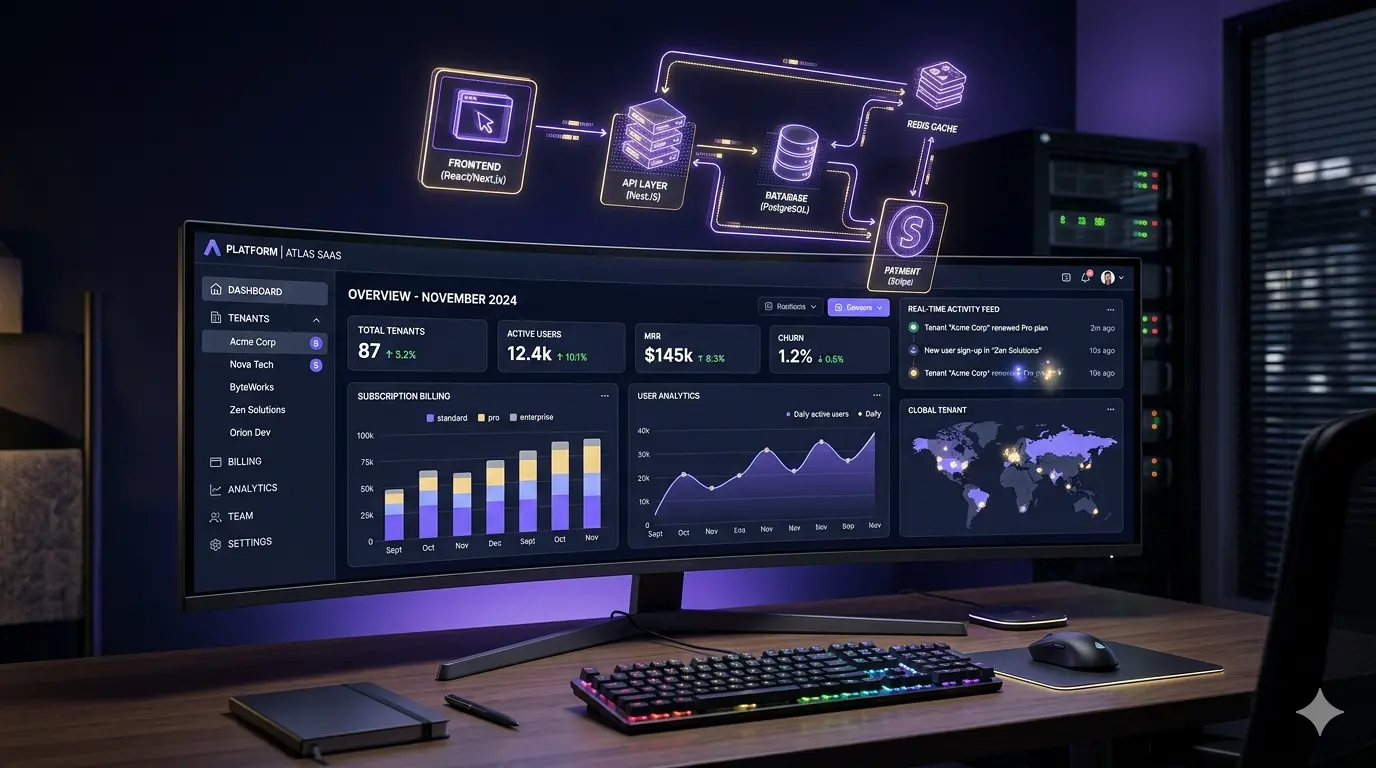
| • The best SaaS tech stack in 2026: Next.js + NestJS + PostgreSQL + Stripe + Redis |
What Makes SaaS Development Different from Regular Web Development?
A standard website or web application serves content to users. A SaaS platform does several things that dramatically increase technical complexity:
Multi-Tenancy: Multiple Customers, One Platform
A SaaS product typically serves hundreds or thousands of separate businesses — each called a “tenant.” Each tenant’s data must be completely isolated from every other tenant’s data. This isolation can be implemented at different levels: database-level (separate database per tenant), schema-level (separate schema per tenant in PostgreSQL), or row-level (a tenant_id column on every table).
The choice between these approaches has massive implications for scalability, maintenance cost, and data security. Row-level isolation is simplest to build and cheapest to operate. Database-level isolation is most secure and easiest to migrate/delete individual tenants. Choosing correctly at the architecture stage saves months of painful refactoring later.
Subscription Billing
SaaS products charge recurring subscriptions — monthly or annual — with multiple pricing tiers, usage-based limits, upgrade/downgrade flows, failed payment handling, dunning management, and proration calculations when customers change plans mid-cycle. Getting billing wrong means lost revenue, angry customers, and accounting nightmares. This is not a feature to build yourself.
Authentication and Role-Based Access Control
SaaS platforms need authentication that works across multiple access methods (email/password, Google OAuth, magic links), with role-based permissions (Admin, Manager, Viewer), invitation systems for adding team members to an account, and session management that works across devices without security vulnerabilities.
Onboarding and Activation
Getting a new user to their “aha moment” — the point where they first experience the core value of your product — is a technical challenge as much as a UX challenge. Interactive onboarding flows, sample data, guided tours, and activation emails must be built into the product architecture from the start.
The Best SaaS Tech Stack in 2026 (With Justification)
There’s no single “correct” SaaS stack — but there is a combination of technologies that has been battle-tested by thousands of production SaaS products and consistently enables fast development, good performance, and long-term maintainability:
| Layer | Technology | Why |
| Frontend | Next.js 15 + TypeScript | SSR for marketing pages, CSR for dashboard, one codebase |
| UI Components | Tailwind CSS + shadcn/ui | Accessible, unstyled components — full design control |
| State Management | TanStack Query + Zustand | Server state caching + global UI state — clean separation |
| Backend API | NestJS + TypeScript | Enterprise structure, testable, scales to microservices |
| Authentication | Auth.js or Clerk | Production-proven, handles OAuth, sessions, MFA |
| Primary Database | PostgreSQL + Prisma ORM | ACID compliance, type-safe queries, great migration tooling |
| Caching | Redis | Session storage, rate limiting, data caching |
| Billing | Stripe | Industry standard, handles all billing complexity |
| Background Jobs | BullMQ | Email queues, report generation, webhook delivery |
| File Storage | AWS S3 or Cloudflare R2 | User uploads, exports, attachments at scale |
| Resend + React Email | Transactional + marketing email, great deliverability | |
| Deployment | Vercel + Railway/AWS | Frontend on Vercel edge, backend on managed infra |
SaaS MVP: What to Build First (and What to Leave Out)
The most expensive mistake in SaaS development is building everything before validating anything. An MVP (Minimum Viable Product) is not a half-finished product — it’s a complete product that solves one core problem, for one specific type of user, well enough that they would pay for it.
What Must Be in Every SaaS MVP
- Core feature — the one thing your product does that makes someone willing to pay
- Authentication — sign up, login, password reset, session management
- Basic billing — ability to take payment (even a single plan) before launch
- Basic onboarding — a path that gets a new user to value within 5 minutes
- Error handling — the app must not crash ungracefully for real users
What Does NOT Belong in a SaaS MVP
- Admin dashboard (you can manage early customers manually)
- Team collaboration features (validate single-user first)
- API for third-party integrations
- Mobile app (web first, always)
- Advanced reporting and analytics
- White-labelling or custom domains for tenants
Every feature outside the core list above should be validated by paying customers asking for it — not assumed. Many SaaS products have failed because teams spent 6 months building features that customers didn’t want, instead of shipping the core value and learning from real usage.
SaaS Development Timeline: What to Expect
| Phase | What Happens | Duration |
| Discovery | Requirements, user stories, architecture decisions, database schema design | 1–2 weeks |
| Design | UI/UX wireframes, design system, component library, approval | 1–2 weeks |
| Core Backend | Auth, database, multi-tenancy, API structure, billing integration | 2–4 weeks |
| Frontend Development | Dashboard, onboarding, settings, billing pages, core feature UI | 3–6 weeks |
| Testing | Unit tests, integration tests, security testing, payment flow testing | 1–2 weeks |
| Launch | Deployment, monitoring setup, DNS, first customer onboarding | 3–5 days |
Total for a focused SaaS MVP: 8–16 weeks. Anything claiming to deliver a SaaS platform in under 6 weeks is either dramatically scoping it down or cutting corners on security, testing, and architecture that will create expensive technical debt.
SaaS Development Cost in India (2026)
| SaaS Product Type | Timeline | Cost (INR) |
| Simple SaaS MVP (1 core feature, basic auth) | 6–8 weeks | ₹1,00,000 – ₹2,50,000 |
| Full SaaS MVP (multi-feature, billing, teams) | 10–14 weeks | ₹2,50,000 – ₹6,00,000 |
| Multi-tenant SaaS Platform (complex) | 16–24 weeks | ₹5,00,000 – ₹15,00,000 |
| Enterprise SaaS (SSO, white-label, compliance) | 24–40 weeks | ₹12,00,000 – ₹40,00,000+ |
| Dashboard / Analytics feature addition | 2–4 weeks | ₹50,000 – ₹2,00,000 |
The 5 Most Common Mistakes That Kill SaaS Products
1. Building in Secret (No Customer Validation)
The most expensive mistake: spending 6+ months building a product without showing it to real potential customers. Validate the core problem and willingness to pay before writing a single line of code. Talk to 20 potential customers. Ask if they currently pay for anything solving this problem. Their answers will shape your entire product.
2. Wrong Multi-Tenancy Architecture
Choosing the wrong tenancy model early creates painful migration later. A product built with shared tables and tenant_id columns that needs to move to isolated databases faces a months-long refactoring effort. Get this decision right in week one — it affects every table, every API endpoint, every query.
3. Building Billing Yourself
Billing looks simpler than it is. Subscription proration, failed payment retry logic, dunning emails, webhook handling, refunds, tax calculation, and plan change edge cases have all been solved by Stripe — which has spent a decade handling every corner case imaginable. Use it. Building billing in-house costs months and creates ongoing maintenance liability.
4. Skipping Testing
SaaS products need to be reliable — customers are paying a recurring subscription and expect the product to work. A production bug that causes data loss or authentication failure can end a SaaS business’s reputation overnight. Automated tests on authentication flows, billing operations, and core features are not optional.
5. No Monitoring
Finding out your SaaS is down from an angry customer email instead of an automated alert is unacceptable. Set up error monitoring (Sentry), uptime monitoring (Better Uptime or Checkly), and API performance monitoring before launch. Alerts should wake you up before your customers notice.
SaaS Architecture: The Components You Need From Day One
Certain architectural decisions that feel like “we’ll add that later” create compounding technical debt when deferred. Add these from day one:
- Tenant isolation — choose your model before the first table is created
- Audit logging — every significant user action recorded with timestamp and user ID
- Soft delete — records marked deleted rather than hard-deleted (customers always ask for data recovery)
- Rate limiting — prevent API abuse from day one
- Email queue — never send emails synchronously in API responses
- Feature flags — ability to turn features on/off per tenant without deployment
Why India Is the Best Place to Build Your SaaS MVP
A SaaS MVP that costs $60,000–$150,000 to build with a US or UK agency costs ₹1,50,000–₹5,00,000 with an experienced Indian development team — at the same technical quality, with the same modern tech stack, and with better communication and collaboration than most businesses expect.
The Indian software development ecosystem has matured significantly — TypeScript, NestJS, Next.js, Prisma, and Stripe are used as standard by senior Indian developers, not as novelties. The cost difference is purely market rate, not quality differential. Our portfolio demonstrates this with real delivered SaaS products.
Conclusion: The Right Foundation Makes Everything Else Possible
Building a SaaS product is a significant technical undertaking — but it’s also one of the most rewarding. A well-built SaaS with genuine product-market fit compounds in value every month: recurring revenue, growing user base, compounding word-of-mouth, and an asset that can be sold or scaled.
The foundation matters more than most founders realize. The architecture decisions made in the first four weeks determine how expensive every future feature is to build, how reliable the product is at scale, and how long the codebase can sustain rapid growth without breaking.
At The Shopify Workshop, we specialize in SaaS MVP development using Next.js, NestJS backends, TypeScript throughout, and Stripe billing — delivering production-ready SaaS products with the architecture to support your next 10,000 customers, not just your first 10. Fixed price. Detailed proposal in 24 hours.
→ Start building your SaaS — free consultation at theshopifyworkshop.com/