
Why Guessing Costs You Money
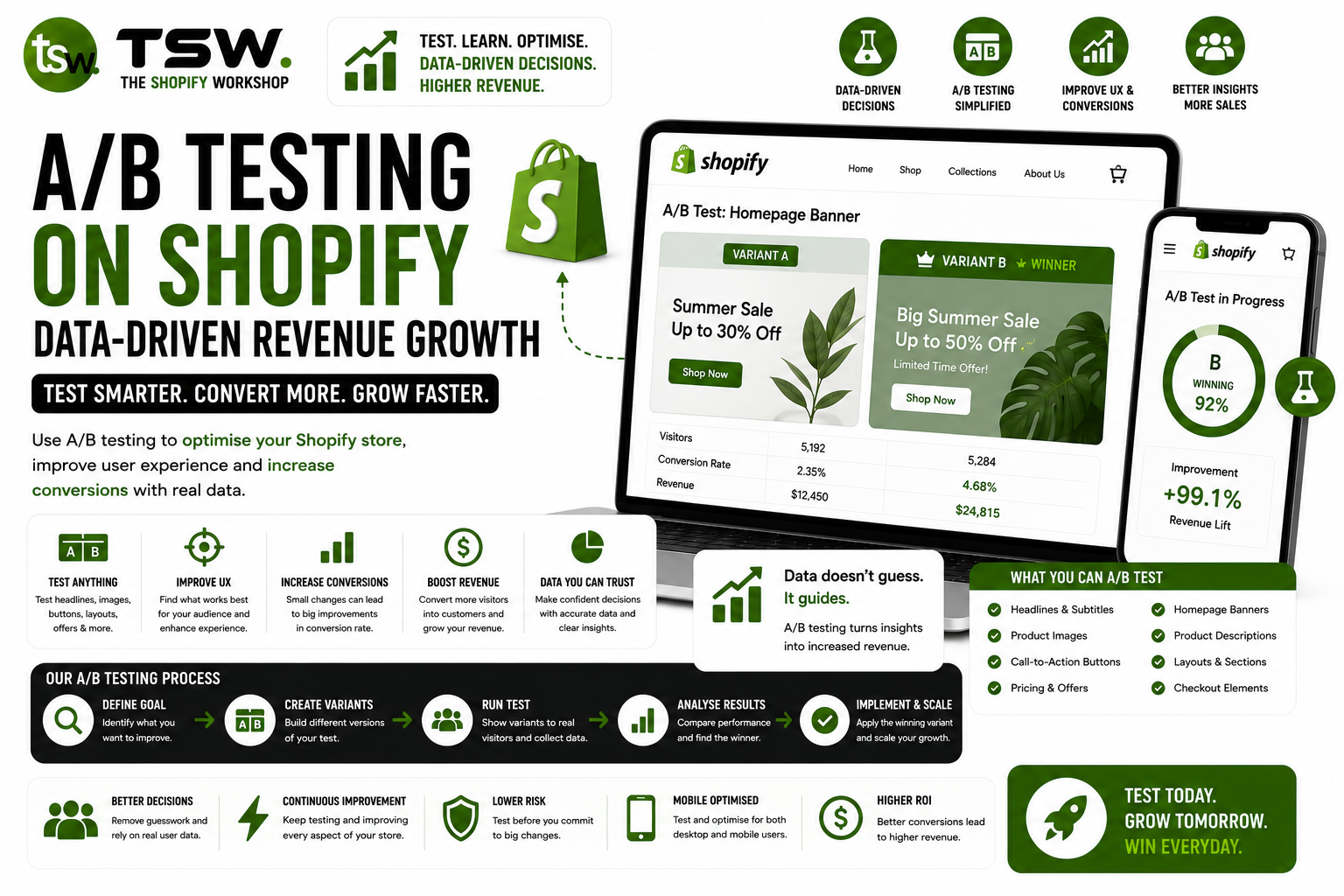
Every design change, copy tweak, or pricing adjustment is a hypothesis. Without testing, you are gambling with your revenue. A/B testing removes the guesswork by letting real customer behaviour determine what works. Our CRO services are built on systematic testing methodologies.
What to Test on Your Shopify Store
High-Impact Test Areas
- Product page layout: Image gallery position, description format, CTA placement
- Pricing presentation: Showing savings, crossed-out prices, bundle offers
- Call-to-action buttons: Colour, text, size, and position
- Navigation structure: Menu categories, mega menus, search prominence
- Social proof placement: Review positioning, trust badges, user counts
- Checkout flow: Guest checkout options, progress indicators, form layout
Prioritising Tests
Use the ICE framework — Impact, Confidence, Ease. Score each potential test on these three dimensions. High-impact tests on high-traffic pages with strong hypotheses should run first.
A/B Testing Tools for Shopify
Google Optimize Alternative
With Google Optimize sunset, merchants need alternatives. VWO, Optimizely, and Convert offer robust Shopify integrations. For budget-conscious stores, Neat A/B Testing provides Shopify-native split testing at accessible pricing.
Theme-Level Testing
Shopify allows duplicate themes. Run an A/B test by splitting traffic between two theme versions using an edge worker or app. This approach handles layout-level changes that JavaScript-based tools struggle with.
Running Statistically Valid Tests
Sample Size Calculations
Before launching a test, calculate the required sample size based on your baseline conversion rate, minimum detectable effect, and desired statistical power (typically 80%). Running tests without enough traffic leads to false conclusions.
Duration and Seasonality
Run tests for at least two full business cycles (typically 2-4 weeks) to account for day-of-week and time-of-day variations. Never end a test early because it “looks like a winner” — regression to the mean is real.
Statistical Significance
Wait for 95% confidence before declaring a winner. Understand the difference between statistical significance and practical significance — a 0.1% improvement might be statistically significant with enough data but not worth implementing.
Interpreting Results
Look beyond the primary metric. A test that increases add-to-cart rate but decreases checkout completion may have a net negative effect. Track secondary metrics including revenue per visitor, average order value, and bounce rate.
Building a Testing Culture
Document every test with its hypothesis, implementation, results, and learnings. Build a knowledge base that informs future tests. Share results across teams to align marketing, design, and development efforts around customer data.
Want to start testing? Our CRO team designs and runs tests that deliver measurable revenue gains.