Going Global Without Losing Local Relevance
International expansion multiplies your addressable market but introduces SEO complexity. Duplicate content across markets, currency handling, language variants, and local search behaviour all need expert handling. Our SEO services include international strategy for global Shopify stores.
URL Structure Decisions
Subdirectories (Recommended)
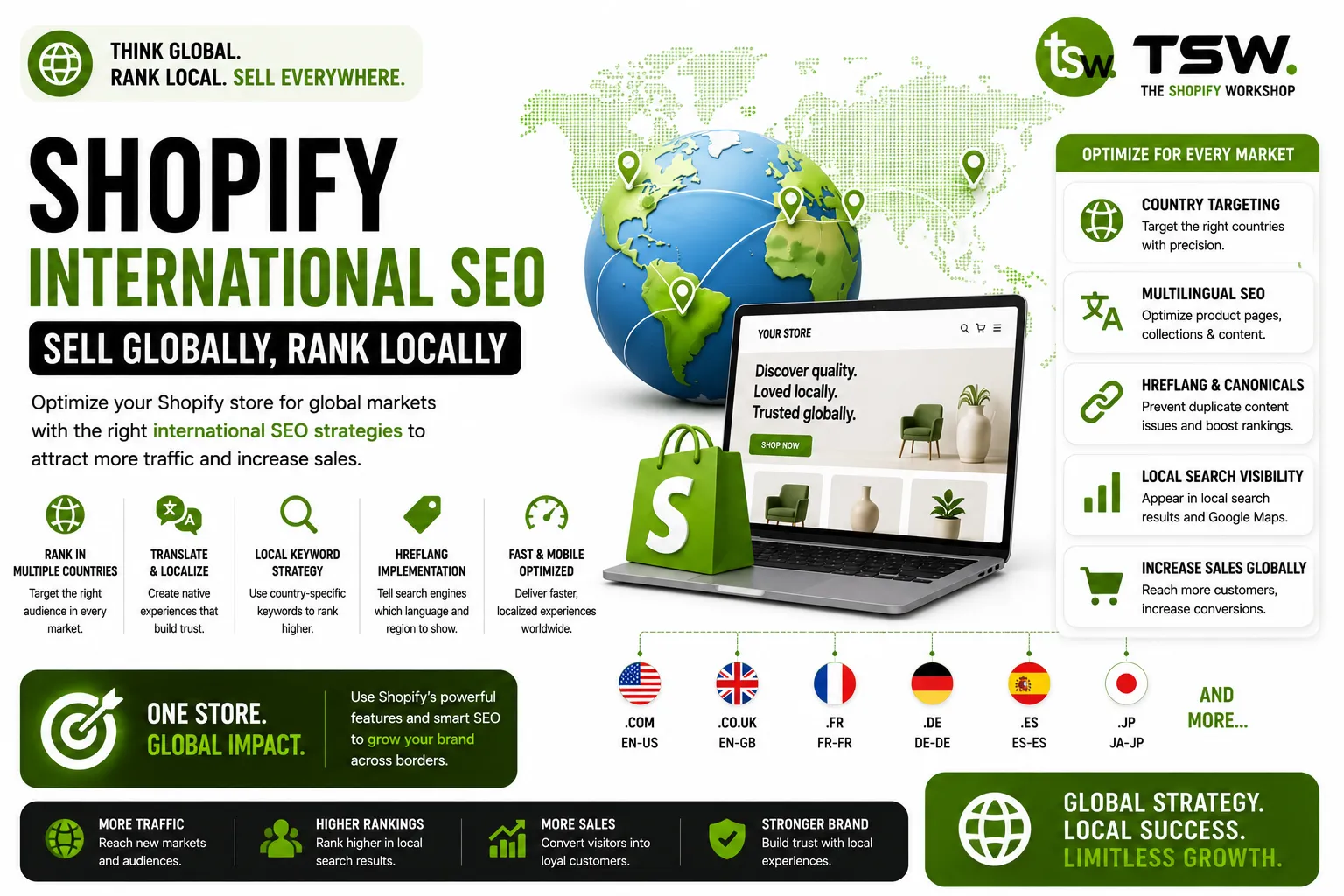
Use /en-gb/, /de/, /fr/ subdirectories for each market. Shopify Markets handles this natively. Subdirectories consolidate domain authority and are the simplest to manage.
Country-Code Domains
Separate domains (.co.uk, .de, .fr) send the strongest geo-targeting signal but split domain authority. Best for large brands with significant resources for each market. More expensive to maintain and build authority.
Subdomains
Subdomains (uk.store.com, de.store.com) offer a middle ground but are treated as separate sites by Google. Generally not recommended for most Shopify stores.
Hreflang Implementation
Why Hreflang Matters
Hreflang tags tell search engines which language and regional version of a page to show in search results. Without proper hreflang, Google might show your US page to UK searchers, or display the wrong language version.
Common Hreflang Mistakes
- Missing return tags (every hreflang must be reciprocal)
- Using wrong language codes (en-gb vs en-GB)
- Missing x-default tag for default/fallback version
- Inconsistent URLs between hreflang and canonical tags
- Not including self-referencing hreflang
Shopify Markets and Hreflang
Shopify Markets generates hreflang tags automatically when you configure markets. Verify the implementation using Google Search Console International Targeting report and hreflang validation tools.
Content Localisation
Translation vs Localisation
Translation converts words; localisation adapts the entire experience. Localisation includes currency, measurement units, date formats, cultural references, seasonal relevance, and local market trends. Machine translation alone is insufficient for ecommerce.
Local Keyword Research
Search behaviour varies by market. German shoppers use different terms than Austrian shoppers despite sharing a language. Conduct keyword research in each target market using native speakers and local search data.
Technical Considerations
Multi-Currency SEO
Product structured data must show the correct currency for each market. Shopify Markets handles currency conversion, but ensure your Product schema dynamically reflects the local currency and price.
Server Location and CDN
Shopify’s global CDN serves content from edge locations worldwide, handling server latency concerns automatically. This is a significant advantage over self-hosted platforms where you would need to configure CDN and server locations yourself.
Market-Specific Optimisation
Each market may need unique strategies. UK stores focus on Google. Chinese market requires Baidu optimisation. Russian market uses Yandex. Japanese market values Yahoo! Japan. Adapt your ecommerce strategy to each market’s search landscape.
Measuring International Performance
Track organic traffic, rankings, and revenue by market segment. Use GA4 with market-specific views. Monitor Google Search Console for each market’s performance. Compare CAC and LTV across markets to prioritise expansion efforts.
Expanding internationally? Get an international SEO strategy tailored to your target markets.