What Is Composable Commerce?
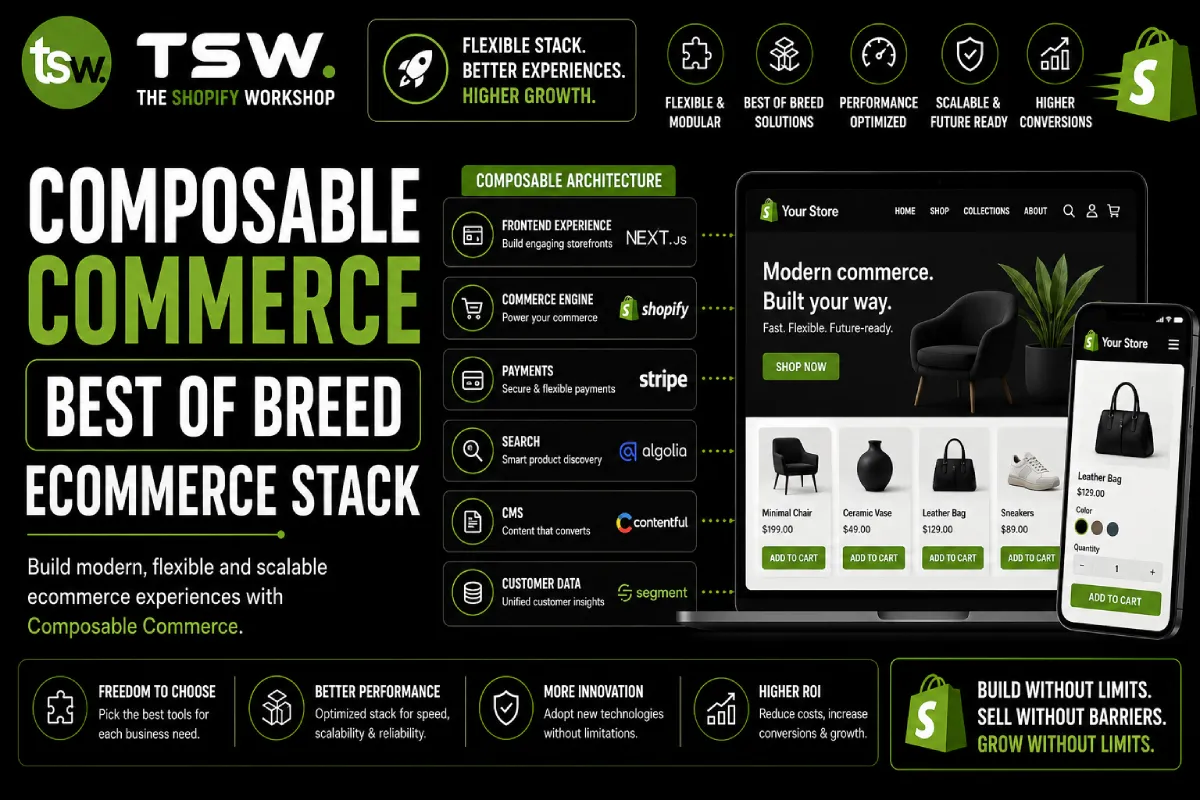
Composable commerce is an architecture where you select best-of-breed services for each commerce capability — CMS, search, payments, personalisation — and compose them into a unified experience through APIs. Unlike monolithic platforms, you are not locked into any single vendor’s ecosystem.
The MACH Principles
Microservices
Each business capability is an independent service that can be developed, deployed, and scaled separately. Payment processing does not depend on search functionality, and a CMS update does not affect the checkout flow.
API-First
All functionality is accessible through APIs. This enables any frontend to connect to any backend service. Shopify’s Storefront API exemplifies this approach for commerce data.
Cloud-Native
Services run on cloud infrastructure with automatic scaling, global distribution, and managed operations. No servers to maintain, no capacity planning, no infrastructure management.
Headless
The presentation layer is decoupled from business logic. Build any frontend experience — web, mobile, IoT, voice — against the same set of APIs. Our development team builds frontends that connect to composable backends.
Common Composable Stack Components
Commerce Engine: Shopify
Shopify handles product management, inventory, pricing, checkout, and order management. Its APIs provide all the commerce functionality you need while handling PCI compliance and payment processing.
Content Management
Headless CMS platforms like Contentful, Sanity, or Storyblok manage rich content independently from commerce data. Marketing teams create landing pages, editorial content, and promotional experiences without developer involvement.
Search and Discovery
Algolia or Searchspring provide advanced search with AI-powered relevance, faceted filtering, personalised results, and analytics. These outperform built-in search for large catalogues with complex attributes.
Personalisation
Dynamic Yield, Nosto, or custom ML models deliver personalised experiences across the site. Product recommendations, content personalisation, and dynamic pricing adapt to each visitor’s behaviour and profile.
Integration Layer
Middleware and Orchestration
An integration layer coordinates communication between services. This can be custom middleware built with Node.js, an integration platform like MuleSoft, or a commerce orchestration layer. Our integration team builds robust middleware for complex architectures.
Event-Driven Architecture
Services communicate through events and webhooks rather than synchronous API calls. Order creation triggers inventory updates, email notifications, and ERP sync simultaneously. This approach is more resilient and scalable than sequential processing.
When Composable Makes Sense
- Enterprise brands with complex requirements no single platform can satisfy
- Businesses with dedicated engineering teams to manage integrations
- Companies needing best-in-class capabilities in specific areas
- Organisations with high-volume, multi-channel commerce operations
When to Stay Monolithic
Most Shopify stores do not need composable architecture. The added complexity, cost, and operational overhead are justified only at significant scale. A well-configured Shopify store with custom theme and strategic app selection serves the vast majority of brands better.
Evaluating your architecture options? Discuss with our commerce architects.