
Custom Shopify Store Cost in 2026: The Complete Guide for UK, Australia, Germany, Netherlands & UAE
If you have ever typed “how much does a Shopify website cost” into Google and walked away more confused than when you started, you are not alone. The internet is full of vague ranges, outdated figures, and pricing tables that conveniently leave out the parts that matter most. This article changes that.
What follows is a detailed, country-specific breakdown of every cost involved in building, launching and running a custom Shopify store in 2026 — written specifically for founders, brand owners, and ecommerce managers based in the United Kingdom, Australia, Germany, the Netherlands, and the United Arab Emirates.
Whether you are launching a new D2C brand, migrating from WooCommerce, or planning a full Shopify Plus build for an established business, this guide gives you real numbers, real context, and a clear framework for making confident decisions about your budget.
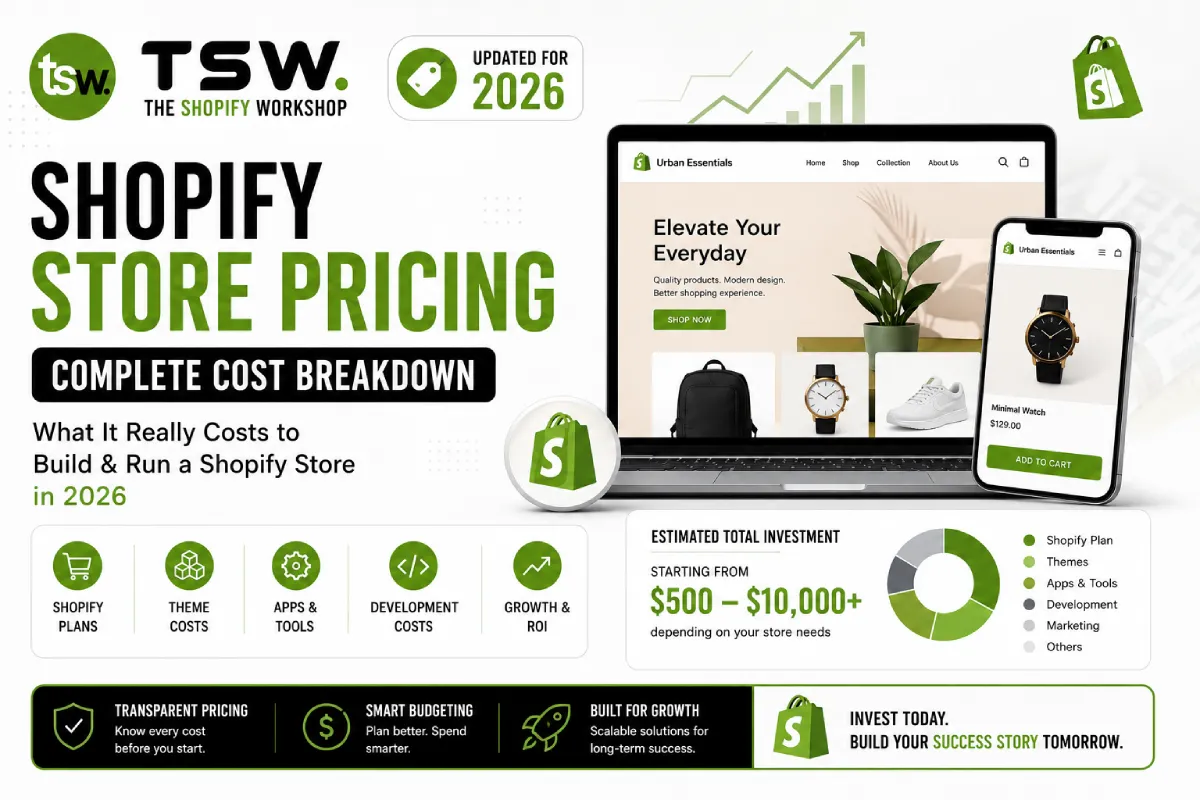
Quick Summary: A professionally built custom Shopify store in 2026 costs roughly £3,000–£40,000+ in the UK, AUD $5,000–$50,000+ in Australia, €3,000–€30,000+ in Germany and the Netherlands, and AED 8,000–150,000+ in the UAE. Enterprise Shopify Plus builds at top agencies can exceed these figures significantly. The platform subscription itself starts at just £25/month — the real investment is in design, development, apps, and ongoing growth.
Table of Contents
- Why Shopify Is the Platform of Choice in 2026
- Where Shopify Is Most Popular: Global Market Overview
- What Determines the Cost of a Custom Shopify Store?
- Shopify Subscription Plans & Monthly Platform Costs
- Premium Theme vs. Custom Theme Development
- Shopify Plus: Enterprise-Level Development Costs
- Headless Shopify & Hydrogen Development
- Shopify App Costs: What to Expect
- Shopify Migration Costs
- Shopify SEO Services Cost
- Speed Optimisation & Core Web Vitals
- Ongoing Maintenance Costs
- Hidden Costs Merchants Rarely Anticipate
- Shopify Website Cost: United Kingdom
- Shopify Website Cost: Australia
- Shopify Website Cost: Germany
- Shopify Website Cost: Netherlands
- Shopify Website Cost: UAE
- Freelancer vs. Agency: Which Is Right for Your Project?
- ROI of Custom Shopify Development
- How to Reduce Your Shopify Development Costs
- Common Mistakes That Inflate Your Budget
- Why Businesses Choose The Shopify Workshop
- Frequently Asked Questions
- Conclusion
Why Shopify Is the Platform of Choice in 2026
Shopify has spent the past decade quietly becoming the infrastructure layer of modern ecommerce. In 2026, it powers over 5.6 million active stores across more than 175 countries, and its merchants collectively processed $378 billion in GMV in 2025 — a 29.5% increase year on year. That is not the growth trajectory of a platform about to be displaced.
So why do fashion brands, jewellery labels, furniture companies, and luxury D2C businesses keep choosing Shopify over its competitors? The answer comes down to four things:
- Managed infrastructure: Shopify handles hosting, security patches, PCI DSS compliance, and uptime — none of which are free on self-hosted platforms like WooCommerce or Magento.
- The largest app ecosystem: Over 12,000 apps in the Shopify App Store covering everything from subscription billing to loyalty programmes, without a single line of custom code required.
- Integrated payments: Shopify Payments and Shop Pay are available in most target markets, reducing checkout friction and eliminating third-party gateway surcharges where supported.
- Speed to market: A brand launching on Shopify with a premium theme can be live and selling within days. That agility has real commercial value — especially for startups.
Compared to the alternatives, Shopify sits in a clear mid-to-enterprise sweet spot. WooCommerce offers flexibility for WordPress-centric businesses but demands developer upkeep, plugin management, and self-managed security. Magento/Adobe Commerce delivers enterprise control but requires teams and infrastructure budgets of £22,000–£40,000+ per year just to maintain. BigCommerce competes closely but has a smaller ecosystem and slower innovation cycle. For most growing ecommerce brands, Shopify delivers the best balance of cost, control, and capability.
Where Shopify Is Most Popular: Global Market Overview
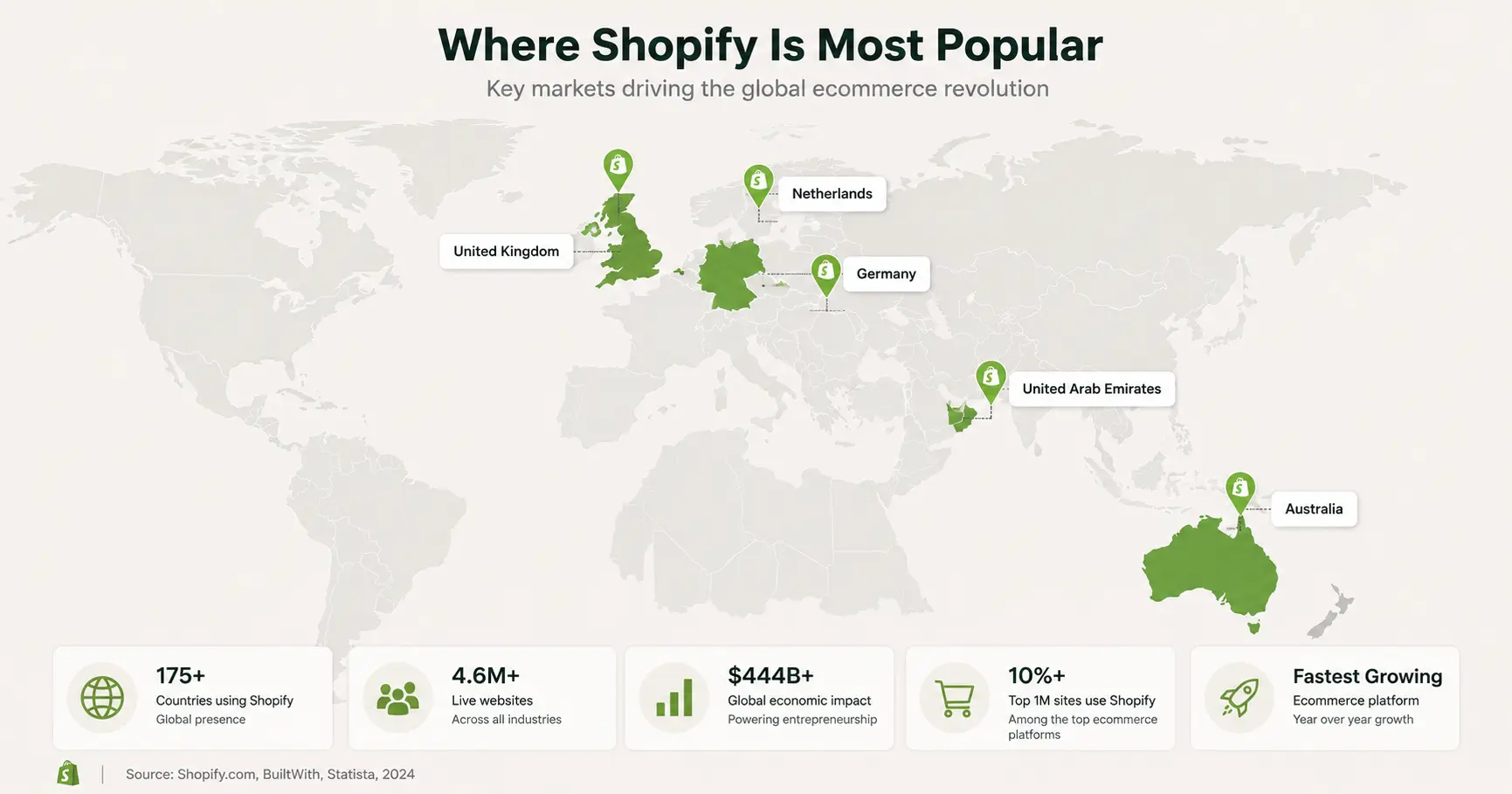
Understanding where Shopify dominates — and why — helps contextualise both the pricing and the competitive landscape in each country. The table below summarises the key markets, followed by individual country profiles.
| Country | Est. Shopify Stores | Ecommerce Market | Currency | Typical Agency Build (Entry) |
| 🇺🇸 United States | ~2.67 million | $1.1T+ (2025) | USD | $5,000–$15,000 |
| 🇨🇦 Canada | ~107,000 | CAD $90B+ | CAD | CAD $5,000–$12,000 |
| 🇬🇧 United Kingdom | ~191,000–220,000 | £286B (2025) | GBP | £3,000–£8,000 |
| 🇦🇺 Australia | ~138,000 | AUD $60.8B | AUD | AUD $5,000–$12,000 |
| 🇩🇪 Germany | ~133,000 | €83–88B | EUR | €3,000–€8,000 |
| 🇳🇱 Netherlands | ~35,000–45,000 | €34B+ | EUR | €2,500–€8,000 |
| 🇫🇷 France | ~71,000 | €160B+ | EUR | €4,000–€12,000 |
| 🇸🇪 Sweden | ~28,000 | SEK 130B+ | SEK | SEK 50,000–120,000 |
| 🇳🇿 New Zealand | ~22,000 | NZD $7B+ | NZD | NZD $6,000–$15,000 |
| 🇦🇪 United Arab Emirates | ~18,000–25,000 | USD $8–11B (B2C) | AED | AED 8,000–20,000 |
The remainder of this article focuses in depth on the United Kingdom, Australia, Germany, the Netherlands, and the UAE — five commercially significant markets where international brands are actively investing in custom Shopify development.
What Determines the Cost of a Custom Shopify Store?
The single biggest source of confusion around Shopify pricing is that “a Shopify website” is not one thing. It is a category that spans from a founder using a free theme to a publicly traded brand running a headless Hydrogen build with custom checkout extensions and a £200,000 development invoice. The following factors determine where your project sits on that spectrum.
1. Complexity of Design
A store built on a premium theme with minor colour and font adjustments costs a fraction of what a fully bespoke design system requires. Custom Shopify theme development involves wireframing, UI design, mobile-first layout architecture, interaction design, and brand integration — all of which takes time and skilled labour.
2. Number of Products and Variants
A jewellery brand selling 30 SKUs has very different requirements from a fashion retailer managing 5,000 SKUs with size, colour, and material variants. Large catalogues require bulk upload systems, advanced filtering, faceted search, and often custom collection logic.
3. Required Functionality
Custom Shopify stores often need features that go beyond what the platform provides out of the box. Common examples include:
- Subscription and recurring billing
- Custom product configurators or builders
- Bespoke checkout flows
- ERP, CRM, or logistics integrations
- Multi-currency and multi-language support
- Wholesale and B2B portals
- Custom loyalty or rewards systems
4. Agency Location and Experience Level
A senior Shopify developer in London charges significantly more per hour than a junior freelancer. Both can produce good work — the question is what level of strategic thinking, quality assurance, and post-launch support you need alongside the build.
5. Project Timeline
Compressed timelines almost always increase cost. Rushing a project means more developers working simultaneously, less testing time, and a higher risk of post-launch fixes.
6. Migration Requirements
If you are moving an existing store from WooCommerce, Magento, or another platform, the migration itself is a significant piece of work — particularly around data preservation, SEO redirect mapping, and integration rewiring.
Shopify Subscription Plans & Monthly Platform Costs
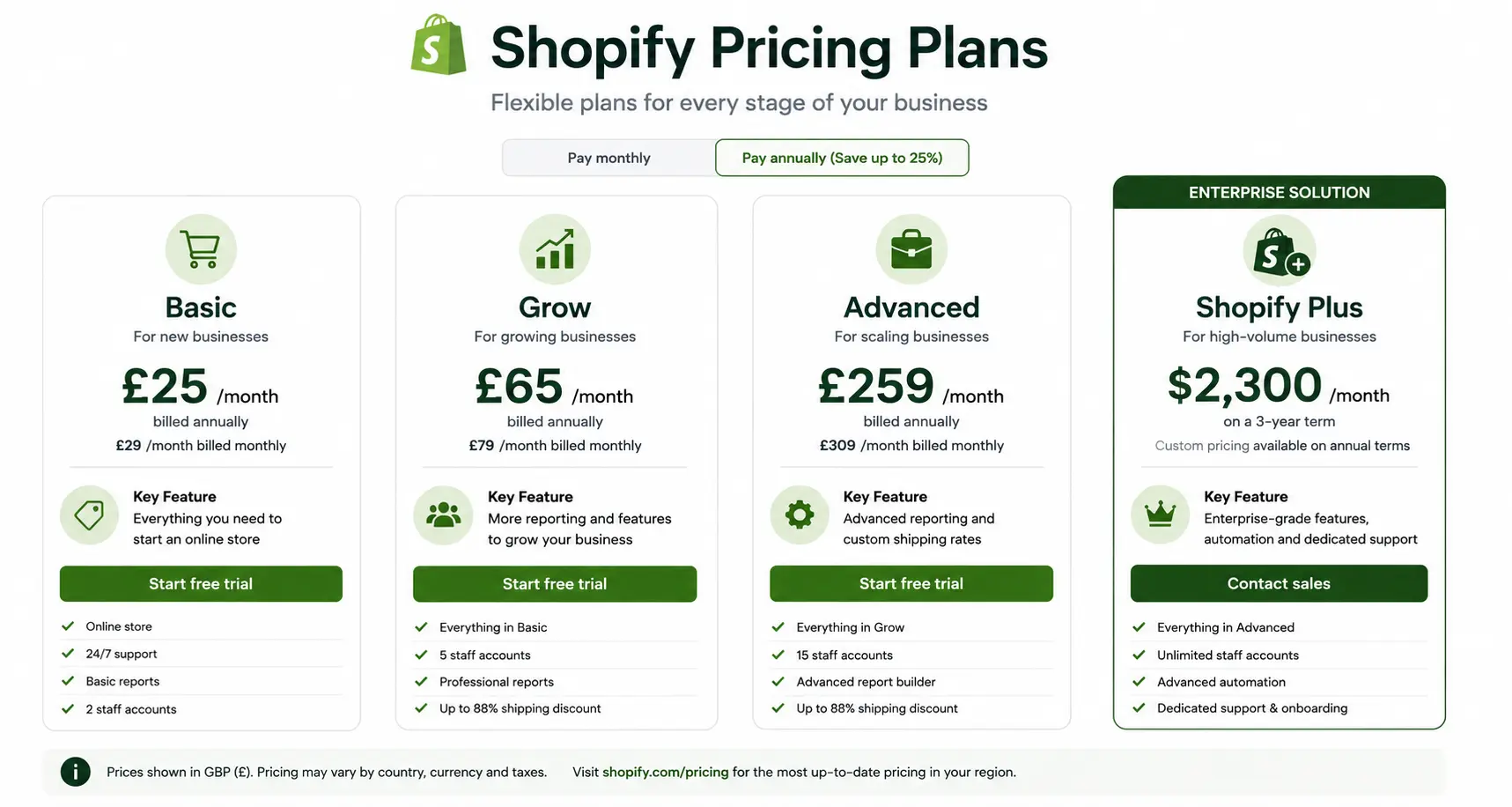
Before you pay a single penny to a developer, Shopify charges a monthly platform fee. Understanding what you get at each tier — and when it makes commercial sense to upgrade — is the foundation of any realistic budget.
| Plan | USD/month | GBP/month | AUD/month | EUR/month | Online Card Rate | 3rd Party Fee |
| Basic | $39 | £25 | AUD $56 | ~€36 | 2.9% + 30¢ | 2% |
| Grow (Shopify) | $105 | £79 | AUD $149 | ~€105 | 2.7% + 30¢ | 1% |
| Advanced | $399 | £299 | AUD $575 | ~€384 | 2.5% + 30¢ | 0.6% |
| Shopify Plus | From $2,300 | By negotiation | By negotiation | By negotiation | ~2.15% + 30¢ | 0.25% (above $1M/month GMV) |
All prices above are billed monthly. Annual billing typically saves approximately 25% across the Basic, Grow and Advanced plans. Shopify Plus is contract-based, usually on a 3-year term starting from $2,300/month, shifting to a revenue-share model above $1 million monthly GMV.
When to Upgrade Plans
- Basic to Grow: When your GMV reaches £1–2M per year. The lower transaction fees and professional reporting tools pay for themselves quickly at this level.
- Grow to Advanced: At around £3–5M GMV per year. Custom reports, third-party calculated shipping, and the reduced gateway surcharge become commercially meaningful.
- Advanced to Plus: At £5M+ GMV or when you need B2B functionality, checkout extensibility, expansion stores, or advanced automation via Shopify Flow.
Pro tip: Shopify charges a surcharge of up to 2% for transactions processed through third-party payment gateways when you are not using Shopify Payments. In markets where Shopify Payments is available — the UK, Australia, and Germany — enabling it is almost always the right commercial decision.
Premium Theme vs. Custom Theme Development
This is the decision that has the single largest impact on your upfront development budget. Understanding the trade-offs honestly is critical.
Premium Themes
Shopify’s official Theme Store offers a curated library of premium themes priced between $100 and $360 as a one-time purchase. Themes like Dawn (free), Prestige, Impulse, and Focal are built to a high technical standard, mobile-optimised, and regularly updated.
- Best for: Startups, brands under £2M revenue, businesses that need to launch quickly
- Development cost to customise: £500–£3,000 for light customisation; £3,000–£8,000 for significant structural changes
- Limitation: You are working within a pre-existing architecture. Advanced custom layouts, unique product experiences, and highly differentiated UX require workarounds that can become technical debt.
Custom Theme Development
A fully custom Shopify theme is built from scratch in Liquid — Shopify’s templating language — designed specifically around your brand, your products, and your customer journey.
- Best for: Established brands, fashion labels, luxury businesses, brands above £2M revenue, and any business where the shopping experience is part of the brand value
- Development cost: £5,000–£40,000+ in the UK; scales with complexity and agency tier
- Performance advantage: Custom themes built on Online Store 2.0 architecture are typically 40–60% faster on Largest Contentful Paint (LCP) than bloated template stores
| Factor | Premium Theme | Custom Theme |
| Upfront cost | £100–£360 theme + £500–£5,000 customisation | £5,000–£40,000+ |
| Time to launch | 1–4 weeks | 4–16 weeks |
| Brand uniqueness | Limited by template constraints | Fully unique |
| Performance (LCP) | Good if lightly customised | Excellent — built to spec |
| Long-term flexibility | Restricted | Unlimited |
| Best revenue stage | Pre-launch to £2M GMV | £2M GMV and above |
For brands who want a fully custom build without the enterprise price tag, The Shopify Workshop offers custom Shopify theme development using Online Store 2.0 architecture — delivering professional, high-performance results for startups and growing brands at a fraction of the typical agency cost.
Shopify Plus: Enterprise-Level Development Costs
Shopify Plus is the enterprise tier of the platform, designed for high-volume merchants, complex operations, and brands that need capabilities beyond what standard Shopify plans provide.
What Shopify Plus Includes
- Up to 10 expansion stores for international markets
- Checkout extensibility — custom checkout UI without Shopify’s standard flow constraints
- Shopify Flow for advanced automation
- B2B and wholesale functionality built into the platform
- Dedicated Shopify Plus merchant success manager
- Negotiated payment processing rates
- Access to Shopify Functions for server-side customisation
Shopify Plus Development Cost Ranges
- Standard Plus build (established mid-market brand): £40,000–£100,000
- Complex Plus build (multiple integrations, custom checkout, ERP): £75,000–£250,000+
- Enterprise-scale Plus (large catalogue, international expansion, headless): £150,000–£500,000+
Shopify Plus makes commercial sense when one or more of the following apply:
- Annual GMV exceeds £5 million
- You operate across multiple countries and need expansion stores
- Your checkout requires custom logic that standard Shopify cannot handle
- You need B2B/wholesale functionality alongside your D2C store
- You require advanced API access or custom integrations with ERP or CRM systems
Headless Shopify & Hydrogen Development
Headless commerce separates the front-end presentation layer from the back-end Shopify platform, allowing developers to build the storefront using frameworks like React while Shopify continues to manage products, orders, payments, and fulfilment behind the scenes. Shopify’s own framework for this, Hydrogen, has matured significantly in 2026 and now includes Storefront MCP support and a more stable release cycle.
When Headless Makes Sense
- Your brand operates a complex content-driven experience such as editorial content, lookbooks, or interactive configurators
- You are building a Progressive Web App (PWA)
- You have multiple front-ends sharing a single Shopify back-end
- Your team has experienced React or Next.js developers in-house
- You are targeting sub-one-second page loads as a genuine competitive differentiator
When Headless Does Not Make Sense
For the vast majority of brands, a well-built custom Liquid theme on Online Store 2.0 matches or exceeds the performance of a headless build — at a fraction of the cost and complexity. Headless introduces significant ongoing development overhead, longer build timelines, and a larger technical team requirement.
Headless and Hydrogen Development Cost Ranges
| Project Scale | Estimated Cost (UK) | Estimated Cost (EU) | Timeline |
| Mid-tier headless build | £30,000–£80,000 | €30,000–€80,000 | 12–24 weeks |
| Enterprise headless build | £80,000–£250,000+ | €80,000–€200,000+ | 6–12 months |
| Full-scale headless with ERP | £150,000–£500,000+ | €150,000–€400,000+ | 9–18 months |
The honest advice: If your brand is generating under £5M per year in revenue and you are considering headless commerce, there is almost certainly a better use of that budget. Invest in a fast custom Liquid theme, CRO, and SEO first — the returns come faster and more reliably.
Shopify App Costs: What to Expect
The Shopify App Store is one of the platform’s greatest assets — and one of the most common sources of budget shock for new merchants. Apps extend Shopify’s native functionality but come with ongoing subscription costs that accumulate rapidly.
Common App Categories and Estimated Monthly Costs
| App Category | Example Apps | Typical Monthly Cost |
| Email marketing | Klaviyo, Omnisend, Mailchimp | £0–£400/month |
| Reviews and UGC | Yotpo, Okendo, Judge.me | £0–£200/month |
| Subscriptions | Recharge, Skio, Seal Subscriptions | £50–£500/month + revenue share |
| Upsell and cross-sell | ReConvert, Zipify, Bold Upsell | £20–£100/month |
| Loyalty programmes | Smile.io, LoyaltyLion, Yotpo Loyalty | £50–£500/month |
| Search and filtering | Boost Commerce, Searchpie | £20–£150/month |
| Inventory and fulfilment | ShipStation, Linnworks, Brightpearl | £50–£500/month |
| Returns management | Loop Returns, AfterShip | £30–£250/month |
| Live chat and support | Gorgias, Tidio, Zendesk | £10–£300/month |
| SEO tools | Plug in SEO, Smart SEO, Schema Plus | £0–£50/month |
A typical mid-market Shopify brand in 2026 spends between £300–£1,200/month on apps. Larger brands with more complex needs routinely spend £1,500–£3,000/month on app subscriptions alone — before paying for development.
Where possible, custom development can replace recurring app costs. The Shopify Workshop’s custom Shopify app development service is designed exactly for this kind of targeted functionality, eliminating ongoing subscription fees and often outperforming the generic app equivalent.
Shopify Migration Costs
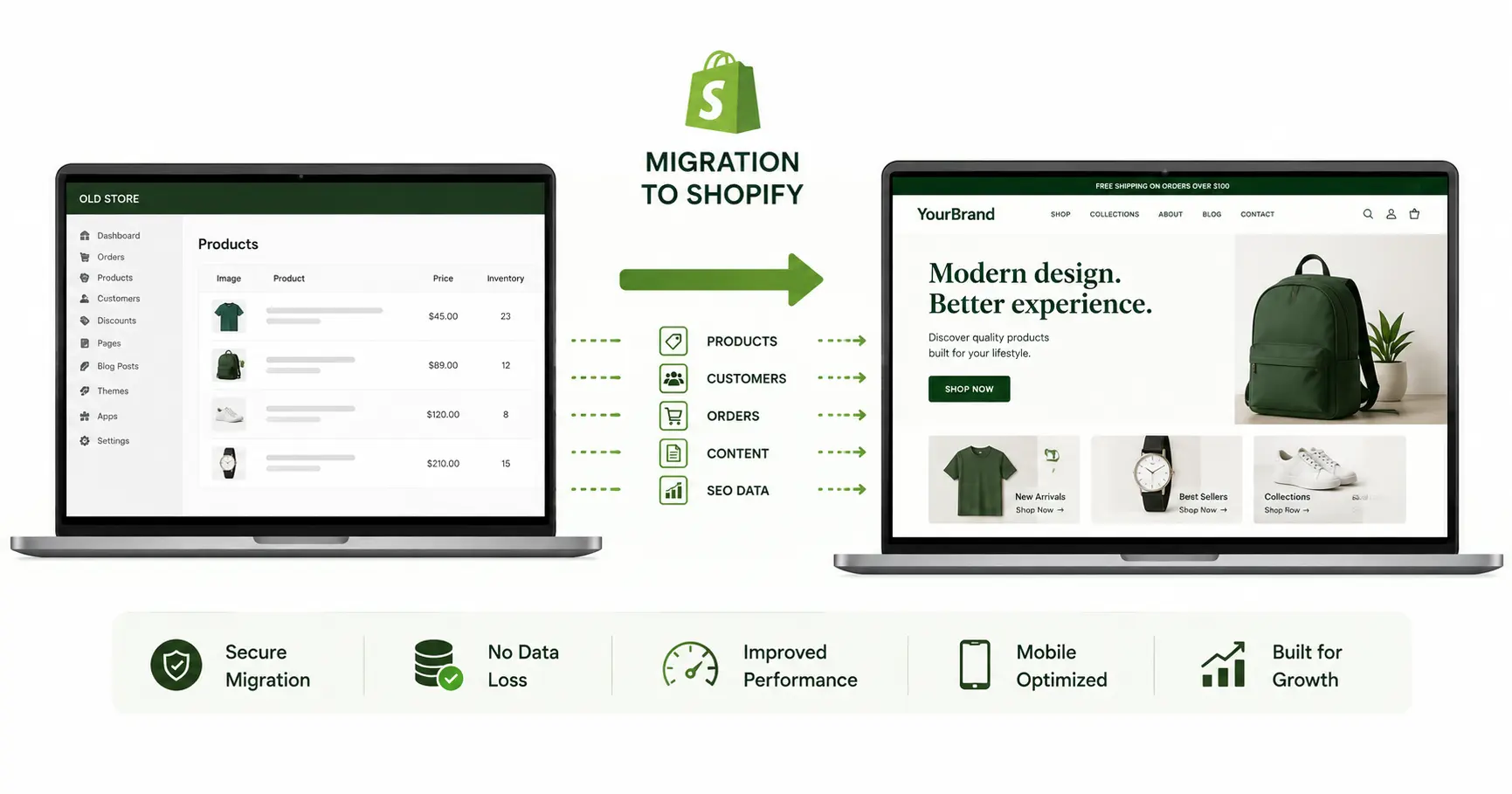
For businesses moving from another platform to Shopify, the migration itself is a significant cost centre that is often underestimated. It is not simply a case of exporting a CSV and importing it into a new store. A proper migration involves data integrity, SEO preservation, payment and fulfilment reconnection, design rebuild, and thorough testing.
Migration Cost by Origin Platform
| Origin Platform | Estimated Migration Cost (UK) | Key Complexity Factors |
| WooCommerce | £3,000–£20,000 | Plugin replacement, redirect mapping, product and order data |
| Magento / Adobe Commerce | £15,000–£80,000+ | Complex data structures, custom modules, B2B functionality |
| BigCommerce | £3,000–£15,000 | API differences, theme rebuild, app replacement |
| Custom-built platforms | £10,000–£100,000+ | No standard export, bespoke data mapping required |
| Squarespace or Wix | £1,500–£8,000 | Limited export capabilities, content-heavy sites |
The Non-Negotiable: SEO Redirect Mapping
The single most overlooked cost in any platform migration is the comprehensive 301 redirect map. URL structures almost always change when moving to Shopify. Without proper redirects in place, every inbound link, every Google index entry, and every piece of organic equity built up over years is broken overnight. Research consistently shows that unmapped migrations result in 20–50% organic traffic loss in the first 90 days — traffic that can take 12–18 months to recover.
A proper SEO redirect audit and implementation typically costs £2,000–£8,000 depending on catalogue size. The Shopify Workshop includes redirect mapping as part of its Shopify migration service.
Shopify SEO Services Cost
Building a great Shopify store is only half the equation. Without SEO, no one will find it. Shopify has strong SEO foundations out of the box — clean URL structures, mobile responsiveness, fast load times — but sustained organic growth requires ongoing strategy, content, technical maintenance, and link building.
What Shopify SEO Services Typically Cover
- Technical SEO audit covering site structure, crawlability, schema, and canonicals
- Keyword research and content strategy
- On-page optimisation including title tags, meta descriptions, and heading structure
- Collection and product page SEO
- Blog content creation and internal linking
- Core Web Vitals and page experience optimisation
- Backlink acquisition
- Local SEO for multi-location or country-specific targeting
Shopify SEO Pricing by Market
| Market | Small Business Retainer | Mid-Market Retainer | Enterprise / Plus Retainer |
| UK (GBP) | £500–£1,500/month | £1,500–£5,000/month | £5,000–£15,000+/month |
| Australia (AUD) | AUD $1,000–$3,000/month | AUD $3,000–$8,000/month | AUD $8,000–$20,000+/month |
| Germany (EUR) | €500–€1,500/month | €1,500–€5,000/month | €5,000–€12,000+/month |
| Netherlands (EUR) | €400–€1,200/month | €1,200–€4,000/month | €4,000–€10,000+/month |
| UAE (AED) | AED 1,500–4,000/month | AED 4,000–12,000/month | AED 12,000–30,000+/month |
The Shopify Workshop provides dedicated Shopify SEO services that cover everything from technical foundation work through to ongoing content and backlink strategy — sized for growing brands rather than enterprise budgets.
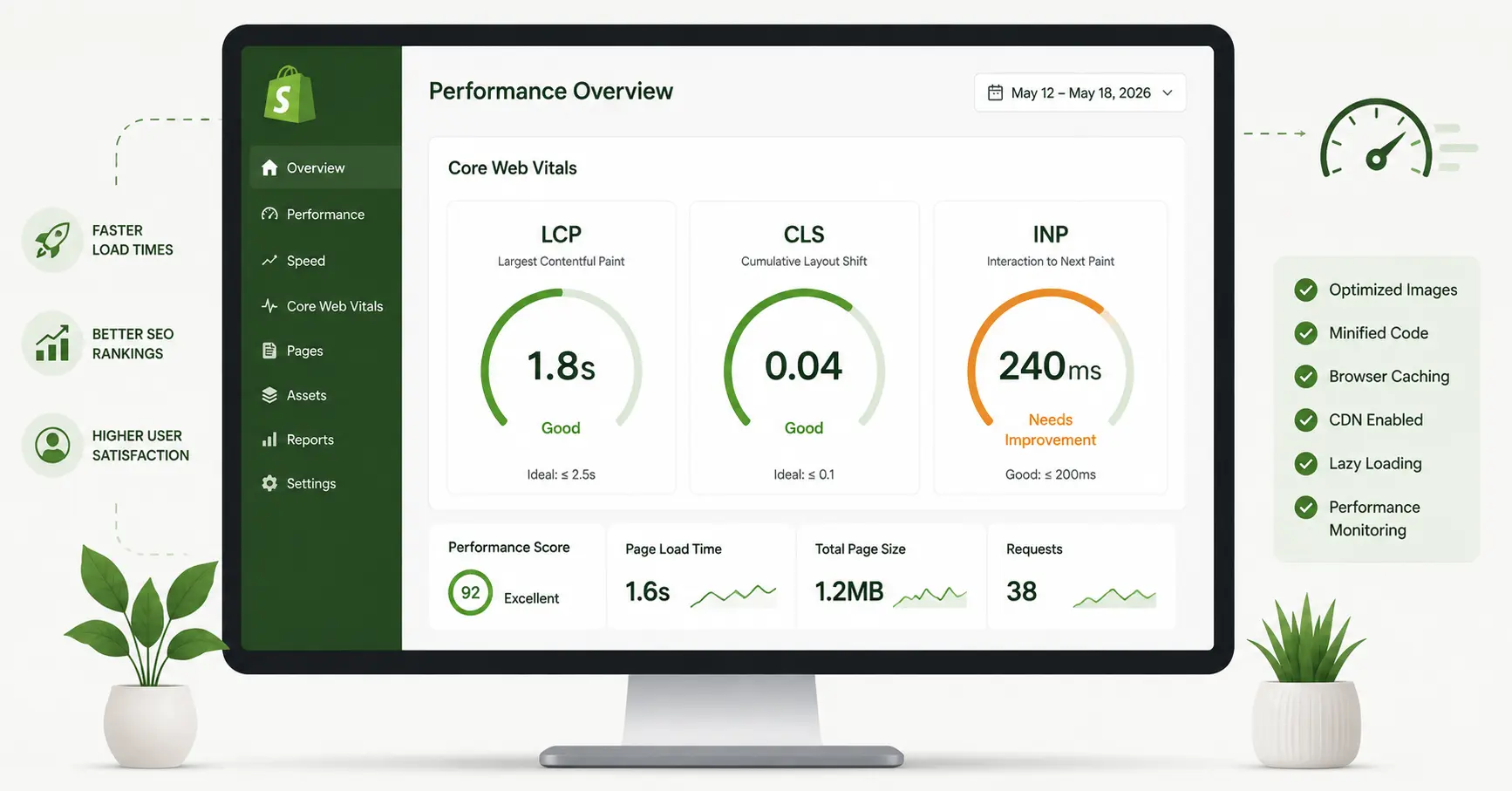
Speed Optimisation & Core Web Vitals
Page speed is not a technical vanity metric. It is a direct driver of revenue. Research commissioned by Google and conducted by Deloitte Digital across 37 retail and travel brands found that a 0.1-second improvement in mobile page speed increased retail conversions by 8.4% and average order value by 9.2%. Separately, Vodafone Italy recorded a 31% improvement in Largest Contentful Paint (LCP) that led to an 8% increase in sales within weeks.
Currently, only approximately 48% of Shopify stores pass all three Core Web Vitals metrics on mobile. This means that more than half of all active Shopify stores are leaving measurable revenue on the table due to preventable performance issues.
What Shopify Speed Optimisation Involves
- Removing unused JavaScript and CSS — eliminating theme bloat
- Lazy loading images and deferring non-critical scripts
- Optimising image formats to WebP and AVIF with appropriate compression
- Reducing app script interference on page load
- Improving Largest Contentful Paint (LCP), Cumulative Layout Shift (CLS), and Interaction to Next Paint (INP)
- Third-party script auditing and management
- Font loading optimisation
Speed Optimisation Cost Ranges
- Basic speed audit and fixes: £500–£2,000
- Full Core Web Vitals optimisation: £2,000–£8,000
- Ongoing performance monitoring retainer: £200–£800/month
The Shopify Workshop offers a dedicated Shopify speed optimisation service that focuses specifically on measurable improvements to Core Web Vitals scores — with a direct eye on conversion impact, not just PageSpeed numbers.
Ongoing Maintenance Costs
A Shopify store is not a set-and-forget investment. Maintaining performance, security, functionality, and compatibility as the platform evolves requires ongoing attention — and for most businesses, ongoing professional support.
What Maintenance Typically Covers
- Shopify platform updates and theme compatibility checks
- App updates and conflict resolution
- Bug fixes and minor feature additions
- Performance monitoring
- Security checks
- Product, collection, and content updates
- Conversion rate monitoring and A/B test implementation
Maintenance Retainer Cost Ranges by Market
| Market | Basic Retainer | Standard Retainer | Growth Retainer |
| UK (GBP) | £200–£500/month | £500–£2,000/month | £2,000–£5,000+/month |
| Australia (AUD) | AUD $500–$1,200/month | AUD $1,200–$3,500/month | AUD $3,500–$8,000+/month |
| Germany (EUR) | €200–€500/month | €500–€2,000/month | €2,000–€5,000+/month |
| Netherlands (EUR) | €200–€600/month | €600–€2,500/month | €2,500–€6,000+/month |
| UAE (AED) | AED 500–1,500/month | AED 1,500–5,000/month | AED 5,000–12,000+/month |
The Shopify Workshop provides structured Shopify maintenance plans for brands that want professional ongoing support without the overhead of a full agency retainer.
Hidden Costs Merchants Rarely Anticipate
Every budget breakdown eventually runs into line items that were not in the original quote. These are the costs that most commonly blindside Shopify merchants — particularly those coming from other platforms or building for the first time.
- Third-party gateway surcharges: If you are not using Shopify Payments, Shopify charges between 0.15% and 2% per transaction on top of your processor’s rate. On a store doing £500,000/year in sales, this is £750–£10,000 per year in additional fees.
- Premium theme costs: Not included in the Shopify subscription. A quality theme costs £80–£290 once-off, but the best themes for specific industries often sit at the top of that range.
- Domain registration and email hosting: Domains cost £10–£40/year. Shopify provides free SSL certificates, but custom email hosting is separate — typically £3–£8 per user per month via Google Workspace.
- App stack creep: What begins as three or four essential apps at £60/month combined can become twelve apps at £800/month within twelve months. This is one of the most consistent budget surprises for growing brands.
- ERP and CRM integration: Connecting Shopify to Xero, QuickBooks, Salesforce, or HubSpot is not always plug-and-play. Custom integration work can cost £2,000–£20,000 depending on complexity.
- GDPR compliance setup: Particularly in Germany and the Netherlands, legal compliance — consent management, privacy policy integration, right-to-erasure workflows — requires specialist attention. Budget £500–£3,000 for proper setup.
- Photography and creative assets: A Shopify theme cannot make poor product photography look good. Professional product photography for a fashion or jewellery brand can cost £1,000–£10,000+.
- Training and handover: Many agencies charge for staff training sessions following a build. Budget £200–£800 for a proper handover that actually empowers your team.
- Localisation for international markets: Multi-language support, local payment methods such as iDEAL in the Netherlands, and currency conversion infrastructure add cost to any cross-border build.
Shopify Website Cost: United Kingdom 🇬🇧
The UK is Shopify’s second-largest market globally by Plus store count, with approximately 191,000–220,000 active stores. The UK ecommerce market reached £286 billion in 2025, making it the third largest globally and the largest in Europe. Online retail accounts for approximately 27–30% of all UK retail spending.
UK Market Context
- VAT: 20% standard rate. Most UK agencies quote excluding VAT.
- Shopify Payments: Available and recommended. Eliminates third-party surcharges.
- Preferred payment methods: Visa/Mastercard, American Express, Apple Pay, Google Pay, Klarna, Clearpay (Buy Now Pay Later).
- Ecommerce growth: Mature market, growing at approximately 3–4% CAGR. High competition makes differentiated brand experiences and strong SEO particularly valuable.
- Dominant Shopify categories: Fashion, beauty, home décor, food and beverage, jewellery.
UK Shopify Developer and Agency Hourly Rates
| Developer Type | Hourly Rate (GBP) |
| Junior freelancer | £25–£50/hour |
| Mid-level freelancer | £50–£85/hour |
| Senior freelancer / Shopify Expert | £85–£150/hour |
| Boutique agency | £80–£150/hour |
| Mid-tier agency | £100–£175/hour |
| Premier / Plus agency | £150–£250+/hour |
UK Project Budget Ranges
| Project Type | Estimated Budget (GBP) | Typical Timeline |
| Theme customisation (light) | £500–£2,500 | 1–2 weeks |
| Theme customisation (heavy) | £2,500–£6,000 | 2–5 weeks |
| Custom Shopify theme (startup) | £3,000–£10,000 | 4–8 weeks |
| Custom Shopify theme (mid-market) | £10,000–£40,000 | 8–16 weeks |
| Shopify Plus build | £40,000–£150,000+ | 4–9 months |
| Headless / Hydrogen build | £60,000–£250,000+ | 6–12 months |
| WooCommerce migration to Shopify | £3,000–£20,000 | 3–8 weeks |
| Magento migration to Shopify | £15,000–£80,000+ | 3–9 months |
Shopify Website Cost: Australia 🇦🇺
Australia is one of Shopify’s strongest markets outside North America, with approximately 138,000 active stores and an ecommerce market valued at AUD $60.8 billion in 2025 — up 8.7% year on year. Australian consumers are highly mobile-first, with approximately 95% smartphone penetration and a rapidly increasing proportion of purchases completed on mobile.
Australia Market Context
- GST: 10% Goods and Services Tax. Applies to digital services purchased from Australian businesses. Most agencies quote excluding GST.
- Shopify Payments: Available in Australia. Supports Visa, Mastercard, and American Express.
- Preferred payment methods: Credit and debit cards, PayPal, Afterpay (very popular), Zip Pay, Apple Pay.
- Ecommerce growth: Strong growth market. Cross-border purchasing from international brands is increasing consumer expectations for polished, fast experiences.
- Dominant Shopify categories: Fashion, health and beauty, sports and outdoors, home and garden, food and beverage.
Australian Shopify Developer and Agency Rates
| Developer Type | Hourly Rate (AUD) |
| Junior freelancer | AUD $40–$80/hour |
| Mid-level freelancer | AUD $80–$130/hour |
| Senior freelancer / Shopify Expert | AUD $130–$200/hour |
| Boutique agency | AUD $100–$175/hour |
| Mid-tier agency | AUD $150–$220/hour |
| Premier agency | AUD $200–$300+/hour |
Australian Project Budget Ranges
| Project Type | Estimated Budget (AUD) | Typical Timeline |
| DIY with premium theme | AUD $500–$2,000 | Self-managed |
| Theme customisation | AUD $2,000–$8,000 | 1–4 weeks |
| Custom theme (startup) | AUD $5,000–$15,000 | 4–8 weeks |
| Custom theme (mid-market) | AUD $15,000–$50,000 | 8–16 weeks |
| Shopify Plus build | AUD $50,000–$200,000+ | 4–9 months |
| Platform migration to Shopify | AUD $5,000–$30,000+ | 4–12 weeks |
Shopify Website Cost: Germany 🇩🇪
Germany is the second-largest ecommerce market in Europe, with annual online goods sales of approximately €83–88 billion. With approximately 133,000 active Shopify stores, the DACH region represents one of Shopify’s most significant European growth markets. German consumers are particularly attentive to data privacy, sustainability credentials, and the legal compliance of the stores they purchase from.
Germany Market Context
- VAT (MwSt): 19% standard rate; 7% reduced rate for certain goods. VAT compliance configuration adds to build cost.
- DSGVO (GDPR): Germany enforces GDPR rigorously. Cookie consent, data processing records, privacy policy compliance, and right-to-erasure workflows are mandatory. Specialist legal setup can cost €500–€3,000.
- Shopify Payments: Available in Germany. Local payment methods are critical — Klarna, PayPal, and SOFORT are expected by German consumers.
- Legal requirements: German online stores must display an Impressum (legal notice), Widerrufsrecht (right of withdrawal), AGB (terms and conditions), and Datenschutzerklärung (privacy policy).
- Accounting integration: Integration with Lexoffice, DATEV, or Sevdesk is commonly required, adding to build complexity.
German Shopify Developer and Agency Rates
| Developer Type | Hourly Rate (EUR) |
| Junior freelancer | €40–€70/hour |
| Mid-level freelancer | €70–€100/hour |
| Senior Shopify freelancer | €100–€150/hour |
| Boutique DACH agency | €80–€140/hour |
| Mid-tier German agency | €100–€160/hour |
| Premier / Plus specialist agency | €140–€200+/hour |
German Project Budget Ranges
| Project Type | Estimated Budget (EUR) | Typical Timeline |
| Simple Shopify setup | €1,000–€3,000 | 1–3 weeks |
| Theme customisation | €2,000–€6,000 | 2–4 weeks |
| Custom theme (startup) | €3,000–€10,000 | 4–8 weeks |
| Custom theme (mid-market) | €10,000–€30,000 | 8–16 weeks |
| Enterprise build with ERP and accounting | €30,000–€100,000+ | 3–9 months |
| Shopify Plus build (DACH market) | €50,000–€150,000+ | 4–9 months |
Shopify Website Cost: Netherlands 🇳🇱
The Netherlands punches well above its geographic weight in ecommerce. With one of the highest internet penetration rates in the world and a population that collectively spent approximately €34 billion online in 2025, the Dutch market is highly sophisticated, mobile-first, and accustomed to seamless digital experiences. Over 70% of Dutch consumers shop online weekly.
Netherlands Market Context
- VAT (BTW): 21% standard rate; 9% reduced rate. EU OSS scheme applies for cross-border B2C sales.
- Shopify Payments: Available in the Netherlands.
- iDEAL: The dominant Dutch payment method, accounting for approximately 65–70% of all online transactions. iDEAL integration is non-negotiable for any Dutch-market store.
- PostNL integration: PostNL is the dominant domestic carrier. Integration with the PostNL API for shipping labels, tracking, and fulfilment is standard practice.
- Language: Dutch-language storefront is expected by local consumers. Conversion rates drop measurably for non-localised stores.
- GDPR: Strictly enforced via the Autoriteit Persoonsgegevens (AP). Cookie consent and data processing compliance are essential.
Netherlands Shopify Developer and Agency Rates
| Developer Type | Hourly Rate (EUR) |
| Freelancer (ZZP’er) — junior | €60–€90/hour |
| Freelancer (ZZP’er) — senior | €90–€150/hour |
| Amsterdam agency — standard | €100–€150/hour |
| Amsterdam agency — premium | €140–€175/hour |
| Shopify Plus specialist agency | €150–€200+/hour |
Netherlands Project Budget Ranges
| Project Type | Estimated Budget (EUR) | Typical Timeline |
| Simple Shopify setup | €1,500–€4,000 | 1–3 weeks |
| Theme customisation with iDEAL setup | €3,000–€8,000 | 3–6 weeks |
| Custom theme with Dutch localisation | €5,000–€15,000 | 6–10 weeks |
| Full custom build with PostNL and iDEAL | €10,000–€30,000 | 8–16 weeks |
| Enterprise build | €30,000–€100,000+ | 3–9 months |
| Headless build (Hydrogen) | €80,000–€150,000+ | 6–12 months |
Shopify Website Cost: UAE 🇦🇪
The UAE represents one of the fastest-growing ecommerce markets in the world, with a projected CAGR of approximately 21% through 2030. The B2C ecommerce market was valued at approximately USD $8–11 billion in 2025, with Dubai accounting for roughly 60% of national volume. Mobile commerce accounts for approximately 78–79% of online transactions — one of the highest rates globally.
UAE Market Context
- VAT: 5% VAT introduced in 2018. All UAE businesses with taxable turnover above AED 375,000 must register. VAT setup and integration adds to project cost.
- Shopify Payments: Not fully available in the UAE. Merchants typically use Stripe, PayTabs, Telr, CCAvenue, or Amazon Payment Services.
- Buy Now Pay Later: Tabby and Tamara are the dominant BNPL providers in the UAE — integration is increasingly expected by consumers.
- UAE Pass: A national digital identity initiative that can be integrated into checkout flows. Studies suggest UAE Pass integration lifts conversion rates by up to 40% for eligible transactions.
- Language: Arabic-language storefront support is important for reaching local Emirati consumers, though English is the primary commercial language in Dubai.
- Shipping: Aramex and Fetchr are the dominant ecommerce delivery providers. Integration typically adds AED 1,500–4,000 to project cost.
- Currency: AED (UAE Dirham) is pegged to USD at approximately 3.67 AED per USD, providing exchange rate stability.
UAE Shopify Developer and Agency Rates
| Developer Type | Hourly Rate (AED) |
| Junior freelancer (local) | AED 100–200/hour |
| Mid-level freelancer | AED 200–350/hour |
| Senior Shopify freelancer | AED 300–500/hour |
| Boutique Dubai agency | AED 300–500/hour |
| Mid-tier agency | AED 400–600/hour |
| Premium / enterprise agency | AED 600–900+/hour |
UAE Project Budget Ranges
| Project Type | Estimated Budget (AED) | Estimated Budget (USD) | Typical Timeline |
| Basic Shopify setup | AED 5,000–10,000 | $1,350–$2,750 | 1–3 weeks |
| Theme customisation | AED 8,000–20,000 | $2,200–$5,500 | 2–6 weeks |
| Professional custom build | AED 20,000–50,000 | $5,500–$13,600 | 6–12 weeks |
| Full custom build with Arabic and payments | AED 40,000–80,000 | $11,000–$22,000 | 8–16 weeks |
| Shopify Plus build | AED 80,000–200,000+ | $22,000–$55,000+ | 3–9 months |
Freelancer vs. Agency: Which Is Right for Your Project?
The choice between a freelancer and an agency is not simply about budget — it is about what kind of support, accountability, and expertise your project genuinely requires.
| Factor | Freelancer | Boutique Agency | Full-Service Agency |
| Typical hourly rate (UK) | £25–£150 | £80–£150 | £120–£250+ |
| Breadth of skills | Usually one specialism | Development plus some strategy | Full-service across design, dev, SEO, CRO |
| Accountability | Individual only | Team-backed | Contractual SLAs |
| Availability | Can be inconsistent | Structured capacity | Dedicated team |
| Best for | Specific, well-scoped tasks | Startups and growing brands | Complex, high-value projects |
| Post-launch support | Variable | Retainer-based | Structured SLA-backed |
| Strategic input | Limited | Moderate | Comprehensive |
| Risk level | Higher — single point of failure | Moderate | Lower |
When a Freelancer Makes Sense
- You have a tightly scoped, technical task such as a specific bug fix or adding a custom section to an existing theme
- You have an in-house project manager and just need execution capacity
- Your budget is genuinely constrained and the task is appropriate for a single specialist
When an Agency Makes Sense
- You are building a new store from scratch and need design, development, and strategy in one team
- You need ongoing support and do not want to manage multiple individual contractors
- Your project involves multiple specialisms such as UX, Liquid development, app integration, SEO, and CRO
- You need contractual accountability and protection
ROI of Custom Shopify Development
The real question most founders and brand managers are asking — underneath all the pricing questions — is: is this worth it? That is a legitimate question, and it deserves an honest answer grounded in data rather than agency marketing.
The Revenue Case for Custom Development
A custom Shopify theme is not just a design exercise. Built correctly, it delivers measurable commercial outcomes:
- Faster page loads drive higher conversion: A 0.1-second mobile speed improvement is associated with an 8.4% increase in conversion rate (Deloitte and Google research). For a store doing £500,000 per year, that is £42,000 in additional revenue per 0.1 seconds of improvement.
- Better UX reduces bounce rate: Stores with well-structured navigation, clear hierarchy, and fast-loading product pages consistently see lower bounce rates and higher average session depth.
- CRO built into the architecture: A custom theme allows you to build conversion optimisation best practices into the foundational structure — cart drawer design, sticky CTAs, trust signal placement — rather than applying them as afterthoughts.
- Brand differentiation commands higher AOV: Premium brand experiences — particularly in fashion, jewellery, and luxury — correlate directly with willingness to pay. A store that looks and feels like a premium brand commands premium prices.
ROI Comparison: Template vs. Custom
| Metric | Template Store | Custom Shopify Store |
| Average PageSpeed (mobile) | 55–70 | 80–95+ |
| LCP (typical) | 2.5–4.5 seconds | 1.2–2.2 seconds |
| Average conversion rate | 1.5–2.2% | 2.2–3.5%+ |
| Bounce rate (mobile) | 50–65% | 35–50% |
| Brand differentiation | Low to medium | High |
| Scalability | Limited | High |
| Investment payback period at £500k GMV | N/A (baseline) | Typically 4–12 months |
Real-world context: A brand doing £500,000 per year with a 1.8% conversion rate that improves to 2.5% after a custom build adds approximately £126,000 in annual revenue on the same traffic. A £12,000 custom theme development cost pays back in under six weeks at that scale.
How to Reduce Your Shopify Development Costs
Reducing cost should never mean accepting lower quality — it means being strategic about where professional investment delivers the highest return and where smart decisions save budget without compromise.
- Start with a strong premium theme, then upgrade: If you are pre-revenue or in early growth, a well-chosen premium theme with light customisation is a sensible starting point. Invest in a full custom build when the revenue justifies it.
- Scope tightly before briefing anyone: Every ambiguous requirement in a brief becomes a cost overrun during development. The clearer your functional specification, the more accurate — and lower — your quote will be.
- Consolidate your app stack: Review every app you pay for. Many mid-market brands are paying for five apps that could be replaced by two, or by a single custom-built feature.
- Enable Shopify Payments in supported markets: Eliminating third-party gateway surcharges of up to 2% can save thousands of pounds per year.
- Choose annual billing: Annual billing saves approximately 25% compared to monthly on Shopify Basic, Grow, and Advanced plans — effectively four months free per year.
- Work with a specialist rather than a generalist: A Shopify specialist builds faster, introduces fewer bugs, and requires less of your time than a generalist web developer learning the platform on your project.
- Avoid headless unless there is a concrete business case: Headless development is the largest single avoidable cost escalation in Shopify projects.
- Separate your migration and your redesign: Attempting to migrate and redesign simultaneously creates maximum complexity. Consider a clean data migration first, then a redesign once the store is stable on Shopify.
Common Mistakes That Inflate Your Shopify Budget
These are the patterns seen repeatedly across Shopify projects that cause budgets to escalate well beyond initial estimates.
- Changing the scope mid-project. Scope changes after development begins are the primary cause of cost overruns. Every new feature request mid-build adds disproportionate cost due to the need to rework completed work.
- Not investing in a proper discovery phase. Skipping discovery to save money almost always results in a longer and more expensive build. A structured discovery phase typically costs £500–£2,000 and can save three to five times its cost in avoided scope changes.
- Choosing the cheapest option without evaluating experience. A junior developer charging £25 per hour who takes twice as long and introduces bugs often costs more in total than a senior developer at £100 per hour who delivers clean code on schedule.
- Ignoring SEO during migration. Skipping redirect mapping during a platform migration can destroy years of organic rankings. The cost to rebuild lost SEO positions typically dwarfs the saving made by cutting the migration budget.
- Over-engineering the first version. Building every feature you might ever want into version one guarantees delays and budget overruns. Successful ecommerce builds launch with what is needed now, then iterate based on real customer behaviour.
- Not budgeting for ongoing maintenance. A Shopify store that receives no professional maintenance degrades over time — apps fall out of compatibility, performance deteriorates, and conversion rates slip.
- Assuming apps can replace custom development for complex needs. For complex requirements — custom B2B portals, unique checkout flows, bespoke configurators — forcing app-based solutions creates technical debt that costs more to fix later than custom development would have cost upfront.
Why Businesses Choose The Shopify Workshop
The Shopify Workshop is a specialist Shopify development agency working with startups, D2C brands, and growing ecommerce businesses across the UK and internationally. Every project is built to a consistent standard: custom, mobile-first, SEO-ready, and performance-optimised from day one.
Services
- Shopify development — full custom store builds on Shopify Online Store 2.0
- Custom Shopify theme development — bespoke Liquid themes designed around your brand
- Shopify app development — custom functionality that replaces expensive recurring app subscriptions
- Shopify SEO services — technical SEO, content strategy, and organic growth
- Shopify speed optimisation — Core Web Vitals and performance improvements tied to conversion outcomes
- Shopify maintenance — structured ongoing support for live stores
- Shopify migration — platform migrations with full SEO redirect management
What Makes The Shopify Workshop Different
The Shopify Workshop is able to deliver fully custom Shopify development at accessible price points because of how the team works — not because corners are cut:
- Online Store 2.0 architecture: Every build uses Shopify’s current platform architecture, which allows for faster, cleaner development with reusable section and block systems.
- Efficient, proven workflows: Structured processes from discovery through to handover eliminate the inefficiencies that inflate agency timelines and invoices.
- Lower operating overhead: Without the large office footprint, management layers, and sales infrastructure of traditional agencies, the savings go directly into the work.
- Reusable component systems: Carefully built, tested components developed across projects are reused intelligently — reducing build time without reducing quality.
- Experienced Shopify-only developers: Deep expertise in Shopify means faster problem-solving and fewer mistakes than generalist web development agencies.
Agency Pricing Comparison
| Provider Type | Typical Starting Price |
| UK boutique agencies | From £5,000–£8,000 |
| Australian agencies | From AUD $10,000–$15,000 |
| German / DACH agencies | From €3,000–€8,000 |
| Netherlands agencies | From €3,000–€8,000 |
| UAE agencies | From AED 8,000–15,000 |
| The Shopify Workshop | Selected custom Shopify projects from under £1,000* |
*Selected startup and small business custom Shopify projects can start from under £1,000 depending on project scope, functionality requirements, and timeline. Not every project falls within this range — complexity and scale determine the final investment. Contact the team for a transparent, no-obligation proposal tailored to your brief.
Frequently Asked Questions
1. How much does a Shopify website cost in the UK in 2026?
The total cost of a Shopify website in the UK in 2026 depends heavily on what you need. The Shopify platform itself starts at £25/month for Basic, rising to £299/month for Advanced and £2,300+/month for Shopify Plus. Development costs are the larger variable: a theme-customised store can cost £500–£5,000 in development fees; a fully custom Shopify build typically ranges from £5,000 to £40,000+ depending on complexity; and a Shopify Plus build at a premier agency can exceed £150,000. Additionally, expect ongoing costs including apps (£200–£1,500+/month), SEO (£500–£5,000+/month), and maintenance (£200–£2,000+/month). For startups and small businesses, The Shopify Workshop offers selected custom Shopify projects starting from under £1,000 depending on scope.
2. What is the difference between a premium Shopify theme and a custom Shopify theme?
A premium Shopify theme is a pre-built design template purchased from Shopify’s Theme Store for £80–£290. It is mobile-responsive, technically sound, and can be customised to some extent through the Shopify editor. A custom Shopify theme is built from scratch in Liquid specifically for your brand. It offers complete creative freedom, optimised performance tailored to your specific product types, and no constraints imposed by a third-party template architecture. Custom themes are typically 40–60% faster on LCP metrics and deliver significantly stronger brand differentiation. The right choice depends on your revenue stage: premium themes are sensible up to roughly £2M GMV; custom themes make commercial sense above that threshold.
3. How much does Shopify Plus cost in 2026?
Shopify Plus is priced starting at $2,300 per month (USD) on a 3-year contract. For merchants processing more than $1 million per month in GMV, Shopify transitions to a revenue-share pricing model at 0.25% of monthly sales. Beyond the platform fee, a Shopify Plus build with a mid-tier agency typically costs £40,000–£150,000 for the development work. Enterprise-scale Shopify Plus projects with complex integrations, headless architecture, and multi-market expansion can reach £250,000–£500,000+. Shopify Plus is commercially justified when your annual GMV exceeds approximately £5 million, when you need B2B or wholesale functionality, or when your checkout flows require custom logic that standard Shopify cannot support.
4. Is headless Shopify worth the extra cost?
For most brands — particularly those generating under £5 million in annual revenue — headless Shopify is not worth the additional cost and complexity. A well-built custom Liquid theme on Online Store 2.0 delivers comparable performance to a Hydrogen build at a fraction of the development cost, with far simpler ongoing maintenance. Headless makes commercial sense when you have a genuine architectural requirement that Liquid cannot meet: a complex interactive configurator, multiple front-ends sharing one back-end, a content-heavy editorial experience, or a Progressive Web App. At brands generating £5–20M+, the payback timeline for headless investment becomes viable over 12–18 months. Below £5M, the same investment in CRO, SEO, and conversion-focused UX consistently delivers faster and more reliable returns.
5. How much does it cost to migrate from WooCommerce to Shopify?
A WooCommerce to Shopify migration typically costs between £3,000 and £20,000 in the UK, depending on the complexity of your existing store. The key cost factors are data migration (products, customers, orders), theme rebuild, plugin and app replacement, integration rewiring, and — critically — SEO redirect mapping. Missing redirect mapping is the most expensive mistake in any migration, as it can destroy years of organic search rankings. For most WooCommerce stores, the migration also represents an opportunity to redesign and improve the shopping experience simultaneously. The Shopify Workshop’s migration service handles all of these components in a structured, single-project engagement.
6. What is Shopify Online Store 2.0 and why does it matter?
Online Store 2.0 is Shopify’s current theme architecture, introduced in 2021 and now the standard for all professional Shopify development. It introduces sections and blocks across every page type — not just the homepage — a JSON-based template system that is dramatically faster to build with, improved metafield support for custom content, and a cleaner separation between theme logic and storefront customisation. For merchants, OS 2.0 means significantly more flexibility in the store editor without requiring developer intervention. For developers, it enables faster builds, cleaner code, and more powerful reuse of components across page templates. Any Shopify build in 2026 that is not on OS 2.0 is using an outdated approach that will require migration in the near future.
7. How much do Shopify apps cost per month?
Individual Shopify apps typically cost between £0 and £500 per month depending on the function and your store’s scale. Many essential apps — basic reviews, simple SEO tools, basic analytics — have usable free tiers. Mid-market brands commonly spend between £300 and £1,200 per month on their combined app stack. Larger brands with subscriptions, loyalty programmes, advanced email marketing, and shipping management in place can easily spend £1,500–£3,000+ per month on apps. The important discipline is conducting a quarterly app audit: remove anything that is not directly contributing to revenue or operational efficiency, and consider custom development for any function you are paying more than £50–£100 per month for long-term.
8. Does Shopify charge transaction fees?
Yes, Shopify charges transaction fees if you use a third-party payment gateway instead of Shopify Payments. The fee is 2% on the Basic plan, 1% on the Grow plan, and 0.6% on the Advanced plan. Shopify Plus merchants pay 0.25% above $1 million monthly GMV. On a store doing £500,000 per year in sales on the Basic plan, using a third-party gateway costs £10,000 per year in additional surcharges. In markets where Shopify Payments is available — UK, Australia, Germany, Netherlands — enabling it is almost always the commercially correct decision.
9. How long does it take to build a custom Shopify store?
Timeline varies considerably based on complexity. A light theme customisation can be completed in 1–2 weeks. A custom theme build for a startup or small brand typically takes 4–8 weeks from brief to launch. A mid-market custom build with multiple integrations and careful QA typically takes 8–16 weeks. A Shopify Plus project with ERP integration, custom checkout extensions, and B2B functionality typically takes 4–9 months. Headless and Hydrogen builds at enterprise scale can take 9–18 months. Clear scoping and a structured discovery phase have the single largest positive impact on timeline adherence.
10. What is the cost of Shopify SEO in 2026?
Shopify SEO services in 2026 range from approximately £500 per month for a basic retainer focused on small stores, through to £5,000–£15,000+ per month for large Shopify Plus stores with thousands of SKUs and competitive search landscapes. Mid-market brands typically spend £1,500–£5,000 per month on a comprehensive SEO retainer covering technical SEO, content production, link building, and performance monitoring. Shopify’s out-of-the-box SEO capabilities are strong foundations, but sustained organic growth requires ongoing strategic investment, particularly in content and authority building. The Shopify Workshop offers structured Shopify SEO retainers for growing brands.
11. Is Shopify good for fashion brands?
Shopify is excellent for fashion brands, and it is one of the most widely used platforms by fashion D2C businesses globally. The platform supports complex variant management across size, colour, and material, high-resolution image galleries and video, lookbook and editorial page designs, size guide integration, Instagram shopping integration, and multi-currency for international fashion brands. Custom Shopify themes for fashion brands are particularly powerful — the ability to build editorial-quality product pages and collection experiences that feel like a premium brand’s own environment, rather than a generic ecommerce template, makes a measurable difference to both brand perception and conversion rate.
12. How much does Shopify cost in Australia in 2026?
In Australia, Shopify Basic costs approximately AUD $56 per month (or AUD $42 per month on annual billing). The Grow plan is approximately AUD $149 per month (or $114 on annual billing), and Advanced is approximately AUD $575 per month. Beyond the platform fee, development costs for an Australian-built custom Shopify store range from AUD $5,000–$15,000 for a startup custom build, AUD $15,000–$50,000 for a mid-market store, and AUD $50,000–$200,000+ for Shopify Plus projects. Afterpay integration is expected by Australian consumers. Shopify Payments is available in Australia, and GST at 10% applies to agency services.
13. What is the cost of Shopify development in Germany?
In Germany, Shopify development agency rates typically range from €80–€200 per hour depending on the agency’s tier and location. Project budgets for custom Shopify builds in Germany start at approximately €3,000 for basic setups and range up to €30,000+ for mid-market custom builds and €100,000+ for enterprise projects. German Shopify stores carry additional legal compliance requirements — DSGVO and GDPR setup, Impressum, Widerrufsrecht documentation, and AGB — which add cost compared to equivalent UK or Australian projects. Preferred German payment methods including Klarna, PayPal, and direct bank transfer also require configuration. VAT (MwSt) at 19% applies to agency services.
14. How much does a Shopify store cost in the UAE?
In the UAE, Shopify store development costs range from AED 8,000–20,000 for theme customisation projects, AED 20,000–50,000 for professional custom builds, and AED 80,000–200,000+ for Shopify Plus projects. UAE-specific considerations that add to build cost include payment gateway setup (Shopify Payments is not fully available in the UAE), 5% VAT integration, Arabic language support, Tabby and Tamara BNPL integration, and Aramex and Fetchr shipping API integration. Dubai-based agencies typically charge AED 300–600+ per hour.
15. What is the difference between Shopify and Shopify Plus?
Standard Shopify plans (Basic, Grow, Advanced) are fully capable ecommerce platforms suitable for the vast majority of online businesses. Shopify Plus is the enterprise tier, adding capabilities that standard plans do not offer: up to 10 expansion stores for international markets, checkout extensibility to customise the checkout flow with custom UI components, Shopify Functions for server-side logic, B2B and wholesale portals built into the platform, advanced automation through Shopify Flow, higher API rate limits, a dedicated merchant success manager, and negotiated payment processing rates. The platform fee starts at $2,300 per month. Shopify Plus is justified for businesses above approximately £5 million GMV annually, and particularly for those with B2B channels or complex checkout requirements.
16. Can I start with a cheap Shopify build and upgrade later?
Yes — and for many businesses this is exactly the right approach. Building your first Shopify store on a well-chosen premium theme with light customisation allows you to validate product-market fit, understand customer behaviour, and generate the revenue that justifies a more significant development investment. The key is ensuring your initial build is done properly — clean code, proper SEO setup, correct URL structure — so that the transition to a custom theme is straightforward rather than requiring a complete rebuild. The Shopify Workshop is experienced in phased build approaches that scale investment alongside business growth.
17. Does Shopify include hosting?
Yes. Shopify is a fully hosted platform, meaning hosting, content delivery, SSL certificates, and infrastructure maintenance are all included in your monthly subscription fee regardless of plan. This is one of Shopify’s most significant advantages over self-hosted platforms like WooCommerce or Magento, where hosting is a separate cost (typically £50–£500+ per month depending on traffic) and the merchant bears full responsibility for server security, uptime, and maintenance. Shopify’s infrastructure is global, highly redundant, and capable of handling extreme traffic spikes — critical for businesses running promotions or seasonal sales peaks.
18. What are Shopify Core Web Vitals and why do they matter for ecommerce?
Core Web Vitals are a set of page experience metrics defined by Google that measure loading performance, visual stability, and interactivity. The three core metrics are Largest Contentful Paint (LCP), Cumulative Layout Shift (CLS), and Interaction to Next Paint (INP). Google uses Core Web Vitals as a ranking signal. More importantly for ecommerce businesses, they are directly correlated with conversion rate and revenue. Research shows that pages achieving Good Core Web Vitals status see 24% fewer page abandonments. Currently only approximately 48% of Shopify stores pass all three metrics on mobile, representing a significant competitive opportunity for brands that invest in dedicated performance optimisation.
19. How do I reduce my Shopify transaction fees?
The most effective way to reduce Shopify transaction fees is to enable Shopify Payments in markets where it is available (UK, Australia, Germany, Netherlands). This eliminates the third-party surcharge entirely. In markets where Shopify Payments is not available, choosing a processor with the lowest surcharge exposure and minimising unnecessary third-party payment options reduces the overall fee burden. Upgrading your Shopify plan also reduces the surcharge rate — from 2% on Basic to 1% on Grow to 0.6% on Advanced. For high-volume stores, the savings on transaction fees from upgrading can more than offset the higher monthly plan cost.
20. What is Shopify Liquid?
Liquid is the templating language that Shopify uses for all theme development. Created by Shopify’s founders, it is a Ruby-based language that combines HTML with dynamic tags and filters that pull in store data — products, collections, cart, customer information — to render pages. Custom Shopify theme development is done in Liquid, and a strong understanding of Liquid is the foundation of professional Shopify development. In Online Store 2.0, Liquid templates are paired with JSON schema files that define the editor UI for each section, allowing merchants to customise content without touching code. The Shopify Workshop’s development team specialises exclusively in Shopify Liquid, ensuring deep expertise rather than the generalist approach of agencies that work across multiple platforms.
21. How much does Shopify maintenance cost per month?
Shopify maintenance retainers in 2026 typically range from £200 per month for basic monitoring and minor fixes at small stores, through to £5,000+ per month for comprehensive growth retainers at larger brands that include ongoing development, CRO testing, performance monitoring, and content updates. A typical mid-market Shopify brand on a structured maintenance retainer spends £500–£2,000 per month. The Shopify Workshop offers maintenance plans designed specifically for growing brands that need professional support without enterprise-level pricing.
22. Is it better to hire an in-house Shopify developer or use an agency?
For most growing ecommerce businesses, an agency or specialist retainer is more cost-effective than an in-house developer. A mid-level in-house Shopify developer in the UK costs £45,000–£70,000 per year in salary plus national insurance, holiday pay, equipment, and management overhead — totalling £55,000–£90,000+ annually for one developer. An agency retainer at £1,500–£3,000 per month (£18,000–£36,000 per year) provides access to multiple specialisms — development, design, SEO, CRO — that a single developer cannot cover. In-house development makes sense when your store requires daily development work and your team is large enough to warrant dedicated resource. For most businesses generating under £10 million in annual revenue, a specialist agency retainer delivers better value.
23. What is the best Shopify theme for jewellery brands?
Jewellery brands on Shopify typically perform best with themes that prioritise large, high-resolution imagery, clean minimal layouts that let the products breathe, and strong mobile product page experiences. Premium themes frequently used by jewellery brands include Prestige, Impulse, and Vantage. However, for established jewellery brands with a distinctive visual identity, a custom Shopify theme — built specifically around the brand’s aesthetic, product photography style, and customer journey — almost always outperforms a template in both brand perception and conversion rate. Custom jewellery store builds allow for features like 360-degree product views, lifestyle photography integration, gift packaging options, and engraving personalisation that template stores struggle to accommodate cleanly.
24. How do I choose the right Shopify agency?
Choosing the right Shopify agency requires evaluating several factors beyond price. Look for: demonstrated Shopify-specific experience rather than general web development, a portfolio that includes stores in your sector, transparency about pricing and process, clear communication in the briefing and discovery stage, evidence of post-launch support and ongoing client relationships, and a genuine understanding of ecommerce outcomes — not just technical delivery. Ask for case studies that include business outcomes such as conversion rates, revenue uplift, and performance improvements. Be cautious of agencies that quote extremely quickly without asking detailed questions about your requirements — it often means the quote is not based on a real understanding of your project.
25. How do I get an accurate quote for my Shopify project?
The most effective way to get an accurate, comparable quote is to prepare a clear brief before approaching agencies. Your brief should cover: your business context and goals, your existing technology stack if migrating, your product catalogue size and complexity, the specific features and functionality you need, your design preferences and brand assets, your target launch date, your ongoing support requirements, and your overall budget range. The clearer your brief, the more accurate and comparable the quotes you receive will be. Avoid asking for a quote based purely on “a Shopify store” — the range of possible costs is too wide for a meaningful answer without specifics. Contact The Shopify Workshop for a structured discovery conversation that produces a clear, detailed, itemised proposal.
Conclusion
The cost of a custom Shopify store in 2026 is not a single number — it is the sum of platform fees, development investment, app infrastructure, ongoing optimisation, and strategic growth services. Understanding each component clearly, and matching your investment to your current revenue stage, is the discipline that separates brands that grow efficiently from those that either under-invest and underperform, or over-invest in complexity they do not yet need.
The five markets covered in this guide — the UK, Australia, Germany, the Netherlands, and the UAE — each have distinct agency pricing structures, local payment requirements, regulatory considerations, and market dynamics. What they share is an increasingly competitive ecommerce landscape where the performance of your Shopify store directly impacts your ability to grow.
The businesses that win are not necessarily those with the largest development budgets. They are the ones that invest at the right time, in the right things, with the right partner — and that maintain and improve their store continuously rather than treating the launch as the finish line.
Whether you are a jewellery brand launching in the UK, a fashion label expanding into the UAE, or a home décor business migrating from WooCommerce in Germany, the fundamentals are the same: a technically sound, mobile-first, conversion-optimised Shopify store built on clean foundations, with professional SEO and ongoing maintenance in place. That is what creates long-term organic growth, brand equity, and commercial return on your ecommerce investment.
Ready to Build Your Custom Shopify Store?
The Shopify Workshop works with startups, growing D2C brands, and established ecommerce businesses to build high-performance Shopify stores that are engineered for conversion, optimised for search, and built to scale.
Every project starts with a transparent, no-obligation conversation about your goals, your timeline, and your budget. There are no vague ranges, no hidden charges, and no templated proposals — just a clear picture of what your project involves and what it will cost.
For qualifying startups and small businesses, selected custom Shopify projects can start from under £1,000 depending on scope and functionality. For larger builds, enterprise projects, and Shopify Plus development, the team provides a detailed, itemised proposal based on your specific brief.
Get in touch with The Shopify Workshop for a free consultation today.