
Going Global with Shopify
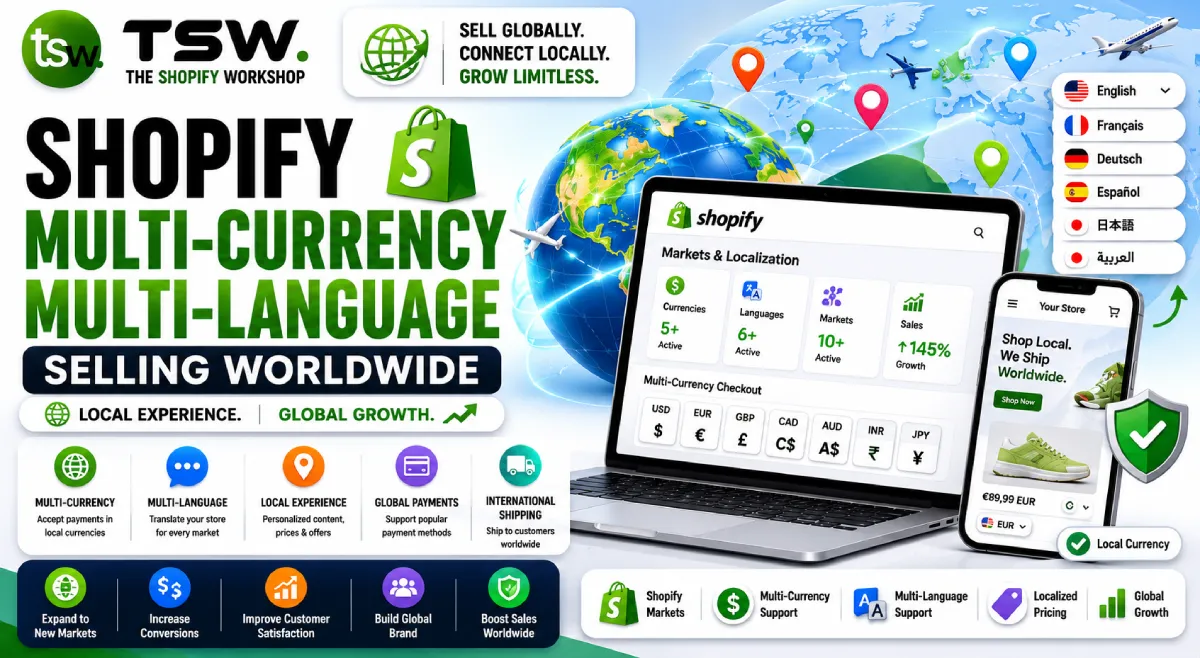
International expansion is one of the most effective growth strategies for established Shopify stores. Shopify Markets simplifies selling across borders with built-in tools for currency, language, domains, and duties. Our strategy team helps brands identify and prioritise international markets.
Shopify Markets Setup
Creating Markets
Define markets by country or region in your Shopify admin. Each market can have unique pricing, currency, language, domain, and product availability. Start with 2-3 priority markets and expand based on demand data.
Currency Configuration
Enable local currencies for each market. Choose between automatic conversion (using Shopify’s exchange rates with optional rounding rules) and manual pricing (set specific prices per market). Automatic conversion is faster to implement; manual pricing gives more control.
Domain Strategy
Use subfolders (/en-gb/, /de/) or country-code top-level domains (.co.uk, .de). Subfolders consolidate domain authority and are easiest to manage. Country domains provide stronger local signals but require separate SEO efforts.
Translation and Localisation
Translation Apps
Weglot, Langify, and Translate & Adapt handle multi-language content. Machine translation provides a starting point; professional translation ensures quality. Prioritise product descriptions, checkout flow, and customer service content for human translation.
Cultural Localisation
Beyond translation — adapt product imagery, marketing messages, and promotional calendars to local culture. British customers expect different tone than American. German consumers value technical specifications; French consumers value aesthetics.
Theme Considerations
Your Shopify theme must handle RTL (right-to-left) languages, variable text lengths (German text is 30% longer than English), and local date/number formats. Build flexible layouts that accommodate these variations.
International Payment Methods
Payment preferences vary by market. Enable local methods: iDEAL in Netherlands, Bancontact in Belgium, Giropay in Germany, and PIX in Brazil. Shopify Payments supports many local methods; third-party gateways fill gaps.
Duties, Taxes, and Compliance
Duty and Import Tax
Show estimated duties at checkout to prevent delivery surprises. Shopify’s built-in duty calculator uses HS codes and product values. Choose between DDP (Delivered Duty Paid — you pay duties) and DDU (customer pays on delivery).
VAT and Sales Tax
Configure tax rates for each market. EU stores must handle VAT collection and remittance for each member state. The UK has its own VAT regime post-Brexit. Ensure compliance with local tax regulations.
International Shipping
Offer affordable international shipping with clear delivery estimates. Partner with carriers experienced in cross-border logistics. Consider regional fulfilment centres to reduce shipping times and costs for key markets.
Measuring International Performance
- Revenue by market: Track sales performance per country/region
- Conversion rate by market: Compare against domestic benchmark
- Return rate by market: Higher returns may indicate sizing or product issues
- Customer acquisition cost: Varies significantly by market
- Currency impact: Monitor exchange rate effects on margins
Planning international expansion? Build your global strategy with our team.