Why Enterprises Are Leaving Magento
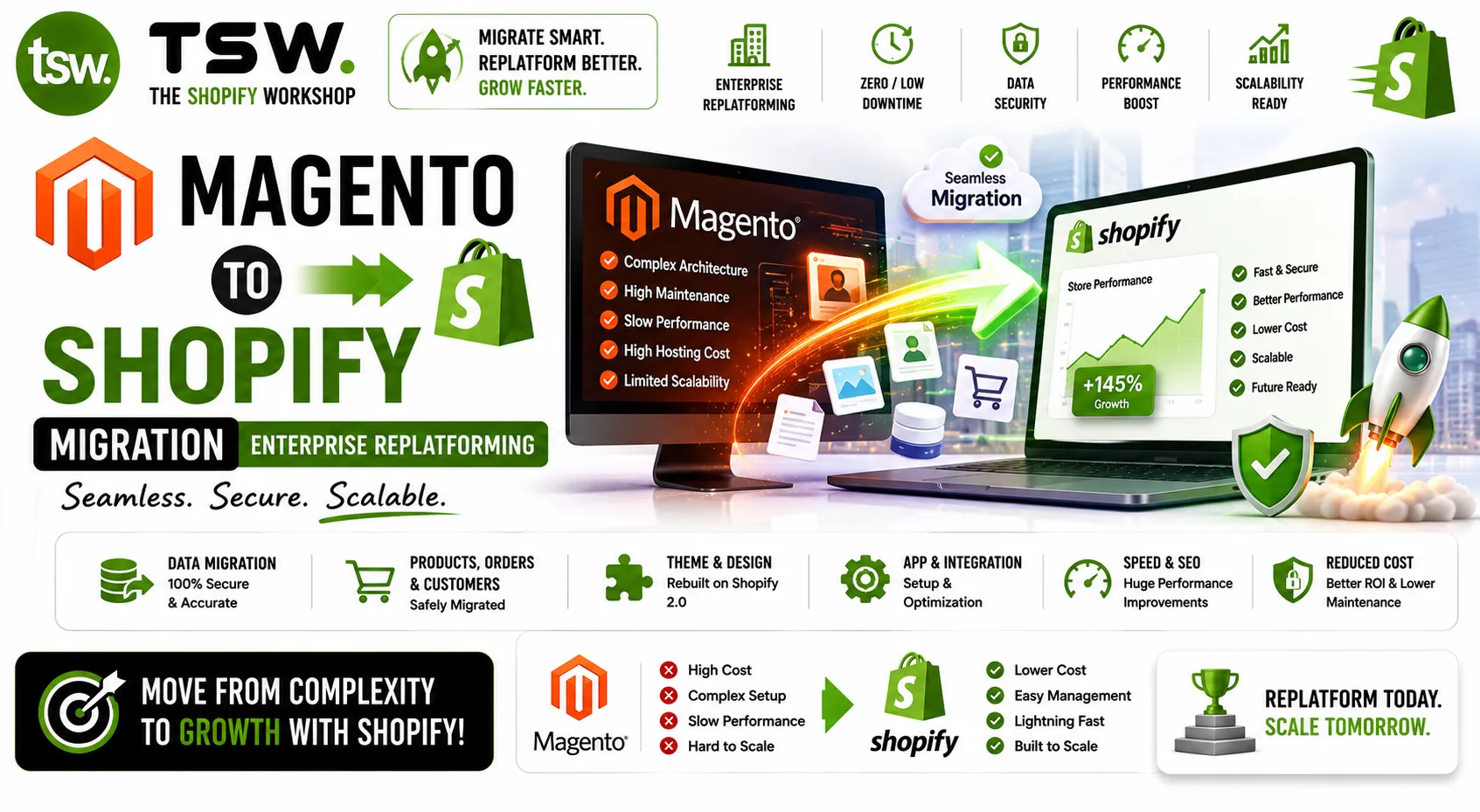
Magento (now Adobe Commerce) served the enterprise market for years, but escalating hosting costs, security maintenance, upgrade complexity, and developer scarcity are driving brands to Shopify Plus. Our migration team has handled dozens of Magento-to-Shopify transitions for enterprise brands.
Pre-Migration Assessment
Feature Audit
Document every Magento feature in use: custom modules, third-party extensions, checkout modifications, customer group pricing, and content pages. Map each to its Shopify Plus equivalent — native feature, app, or custom development.
Data Inventory
- Products: Simple, configurable, bundle, grouped, virtual, downloadable
- Categories: Category tree with assignments and custom attributes
- Customers: Accounts, addresses, groups, and order history
- Orders: Historical orders for customer reference and reporting
- Content: CMS pages, blocks, widgets, and blog posts
- URL redirects: Complete URL mapping for SEO preservation
Integration Mapping
Identify all system integrations — ERP, CRM, PIM, WMS, marketing platforms, and payment gateways. Each needs a Shopify Plus integration path, whether through native connectors, middleware, or custom API development.
Migration Execution
Phased Approach
Migrate in phases: data migration first (products, customers), then theme development, then integration reconnection, then testing, then cutover. Never attempt a big-bang migration without extensive testing.
Product Data Migration
Magento’s attribute-based product model differs from Shopify’s variant model. Map configurable product attributes to Shopify variants. Custom attributes become metafields. Bundled products need custom solutions or apps.
Customer and Order Migration
Migrate customer accounts and order history. Customers will need to reset passwords (different hashing algorithms). Communicate the change proactively with password reset emails and incentives to re-engage.
Content Migration
Magento CMS content uses widgets and shortcodes that have no Shopify equivalent. Convert content to HTML and Liquid. Rebuild dynamic content blocks as Shopify sections. This is typically the most labour-intensive part of migration.
SEO Preservation
URL Redirect Strategy
Magento URLs follow a completely different pattern than Shopify. Create comprehensive redirect maps for every product, category, and content page. Our SEO team monitors search performance throughout and after migration.
Structured Data Continuity
Ensure schema markup on the new Shopify store matches or exceeds what existed on Magento. Product, Review, BreadcrumbList, and Organization schema should be implemented before cutover.
Post-Migration Optimisation
Performance Improvement
Shopify Plus typically delivers significantly better performance than Magento. Capitalise on this with speed optimisation and conversion rate improvements that leverage the new platform’s strengths.
Feature Enhancement
Use the migration as an opportunity to implement features that were difficult or expensive on Magento — Shopify Flow automation, native B2B, Checkout Extensibility, and modern theme architecture.
Timeline and Investment
Enterprise Magento migrations typically take 3-6 months with dedicated teams. Budget $50,000-$200,000+ depending on catalogue size, custom feature complexity, and integration requirements. The long-term savings on hosting, maintenance, and development justify the investment.
Planning a Magento migration? Get a free migration assessment from our enterprise team.