Inventory Is Your Biggest Asset and Risk
Poor inventory management leads to stockouts (lost sales), overstock (tied-up capital), and inaccurate listings (customer frustration). Effective inventory systems balance product availability with cash flow efficiency. Our strategy team helps brands optimise their inventory operations.
Shopify Inventory Basics
Multi-Location Inventory
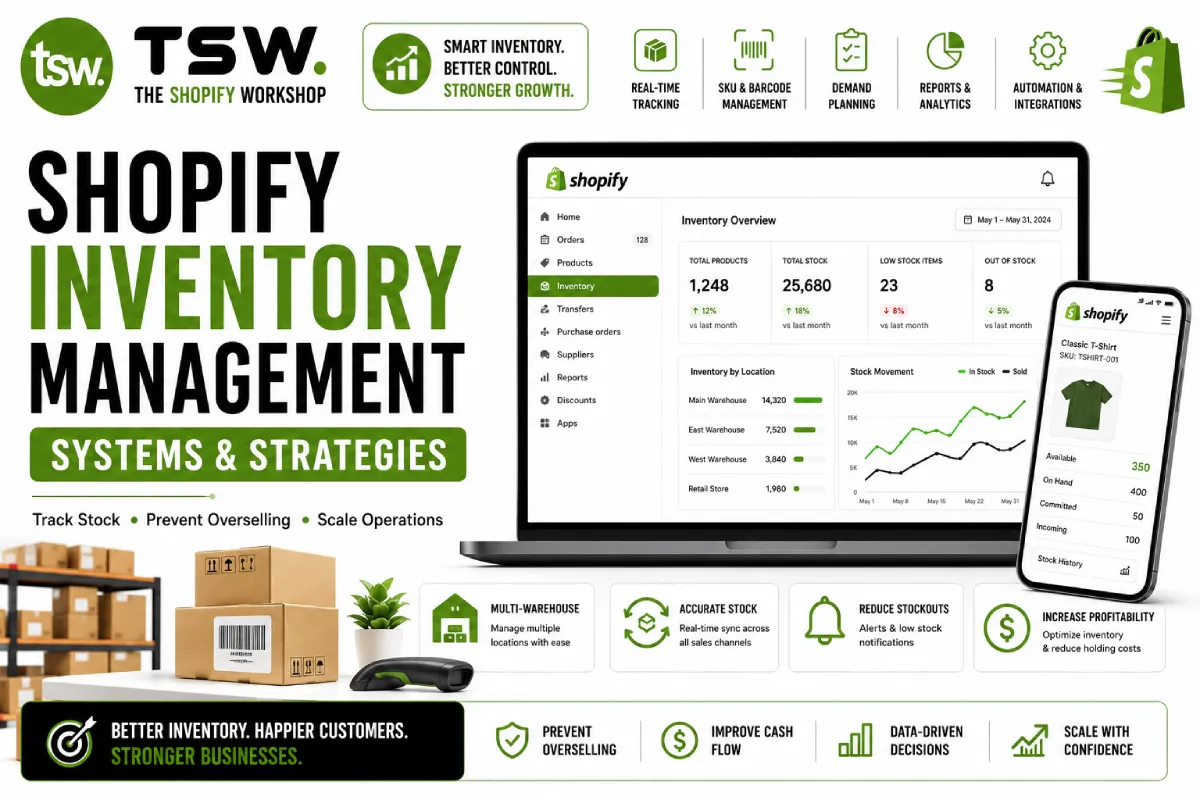
Shopify supports inventory tracking across multiple locations — warehouses, retail stores, pop-up shops, and 3PL facilities. Each location maintains independent stock levels. Orders can be fulfilled from any location based on proximity or availability rules.
Inventory Tracking
Enable inventory tracking for each product variant. Set quantities, receive alerts at configurable thresholds, and prevent overselling. Shopify automatically reduces inventory on purchase and restores it on cancellation or return.
Demand Forecasting
Historical Analysis
Analyse sales velocity by product, considering seasonality, promotional periods, and trend cycles. Calculate average daily sales, weekly patterns, and monthly trends. Use this data to predict future demand and set reorder points.
Safety Stock Calculation
Buffer inventory protects against demand spikes and supply delays. Calculate safety stock using: Safety Stock = Z-score × Standard Deviation of Demand × Square Root of Lead Time. Higher service levels require larger safety stock buffers.
Reorder Points
Set reorder points based on lead time demand plus safety stock. Trigger purchase orders when inventory reaches the reorder point to avoid stockouts. Automate alerts using Shopify Flow or inventory management apps.
Inventory Management Systems
Shopify Native Tools
Suitable for small to medium stores. Manage inventory through the admin, set alerts, and handle basic multi-location. Limited in reporting, forecasting, and automation capabilities.
Third-Party IMS
Apps like Stocky (Shopify’s own), Skubana, or TradeGecko provide advanced features — purchase order management, demand forecasting, bundle inventory tracking, and multi-channel sync. Choose based on catalogue complexity and order volume.
ERP Integration
For larger operations, integrate Shopify with ERP systems like NetSuite, SAP Business One, or Cin7. Our integration team builds custom connectors for real-time inventory synchronisation between Shopify and enterprise systems.
Multi-Channel Inventory
If you sell on Shopify, Amazon, eBay, and retail, inventory must sync across all channels in real time. Overselling due to sync delays damages customer trust and creates operational headaches. Centralised inventory management is essential for multi-channel brands.
Fulfilment Strategy
In-House vs 3PL
Fulfil in-house for control and cost efficiency at low volumes. Switch to 3PL (Third-Party Logistics) when order volume exceeds your team’s capacity. 3PLs offer economies of scale in shipping, professional warehouse operations, and geographic distribution.
Shopify Fulfillment Network
Shopify’s own fulfilment service distributes inventory across multiple locations for fast delivery. It integrates natively with your Shopify store and handles picking, packing, and shipping.
Key Metrics
- Inventory turnover: How many times stock is sold and replaced per year
- Days of supply: How many days current inventory will last
- Stockout rate: Percentage of time products are unavailable
- Carrying cost: Cost of holding inventory (storage, insurance, depreciation)
- Order accuracy: Percentage of orders fulfilled correctly
Need help with inventory operations? Optimise your inventory systems with our operational consultants.