
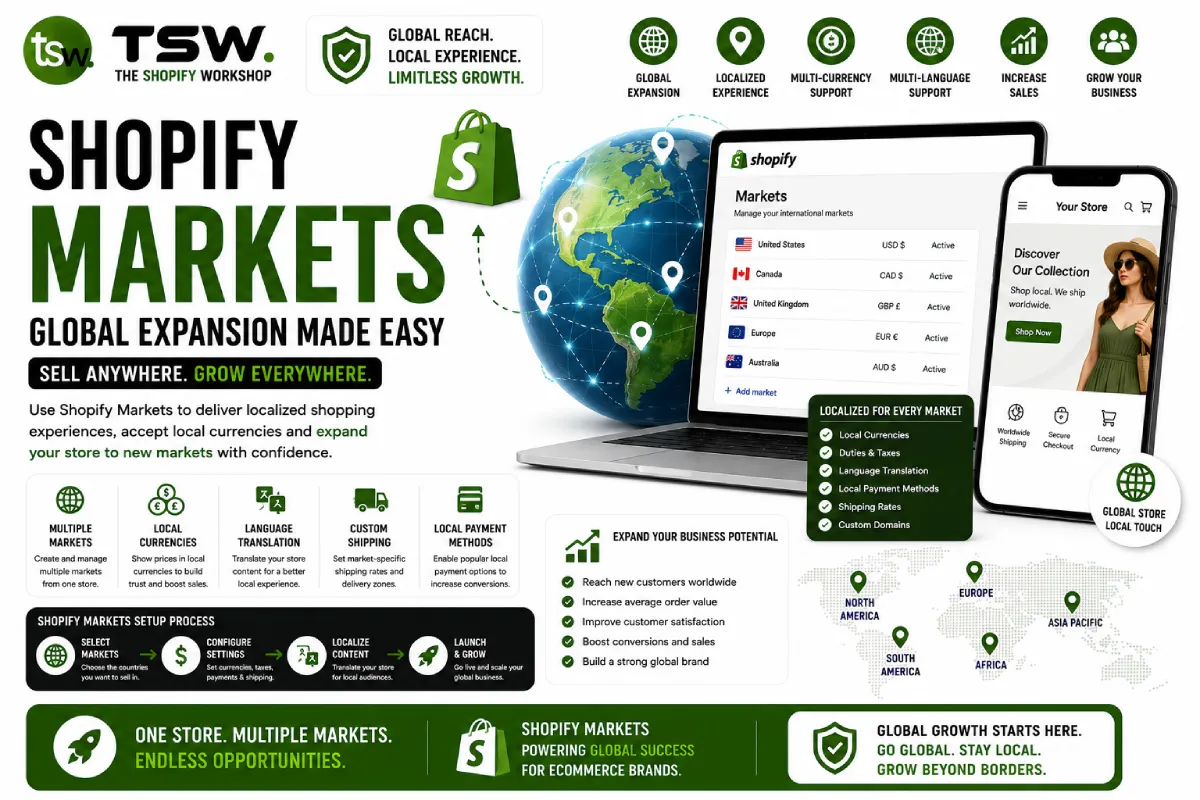
What Is Shopify Markets?
Shopify Markets is Shopify’s built-in international selling solution that lets you manage multiple countries and regions from a single store. Instead of creating separate stores for each market, Markets handles currency conversion, language translation, local payment methods, and duties estimation — all from your existing Shopify admin.
For UK-based merchants looking to sell globally, Markets eliminates the technical complexity that traditionally required expensive multi-store setups or custom development. Combined with strategic market selection, it’s the fastest path to international revenue.
Setting Up Your First International Market
Navigate to Settings → Markets in your Shopify admin. Your primary market (typically the UK) is already configured. Click “Add market” to create regions — you can group countries logically (e.g., “Europe,” “North America,” “Asia-Pacific”) or target individual high-value countries. Each market gets its own currency, pricing adjustments, and domain strategy.
Choose between subfolders (yourstore.com/fr/), subdomains (fr.yourstore.com), or country-specific domains (yourstore.fr) for each market. Subfolders are the simplest option and consolidate SEO authority under a single domain.
Currency and Pricing Strategy
Markets supports two pricing approaches: automatic conversion using real-time exchange rates, or manual pricing where you set fixed prices per market. Automatic conversion is easier to manage but can result in odd-looking prices (£49.99 becomes €58.37). Enable rounding rules to clean up converted prices — rounding to .99 or .95 endings maintains pricing psychology across currencies.
For markets where you want complete pricing control, use market-specific product pricing to set exact values. This is essential for markets with different competitive dynamics or VAT-inclusive pricing requirements.
Language and Content Localisation
Shopify Markets integrates with the Translate & Adapt app to provide translated content for each market. While machine translation handles the bulk of work, invest in professional translation for key pages — homepage, product descriptions, and checkout — to build trust with local shoppers.
Beyond language, adapt your content culturally. Product descriptions, size guides, and marketing messaging should resonate with local audiences. A localised marketing strategy dramatically improves conversion rates in new markets.
Duties, Taxes, and Compliance
International selling introduces tax complexity. Markets estimates duties and taxes at checkout when enabled, preventing surprise charges that cause delivery refusals. Configure duty collection as either DDP (delivered duty paid, where the customer pays at checkout) or DAP (delivered at place, where the customer pays on delivery). DDP creates a better customer experience and is recommended for most merchants.
Ensure your store infrastructure supports the regulatory requirements of each target market — particularly GDPR for European customers, which requires specific consent mechanisms and data handling procedures.
Local Payment Methods
Payment preferences vary dramatically by country. While credit cards dominate in the UK and US, European customers prefer iDEAL (Netherlands), Bancontact (Belgium), and SEPA direct debit. Asian markets favour digital wallets like Alipay and GrabPay. Shopify Payments supports many local methods automatically when you activate a market.
Measuring International Performance
Track each market’s performance through Shopify’s analytics, monitoring conversion rates, average order value, and return rates by region. Markets that underperform may need pricing adjustments, better localisation, or targeted paid advertising to build awareness. Our team helps merchants identify and optimise their highest-potential international markets through data-driven strategy.