
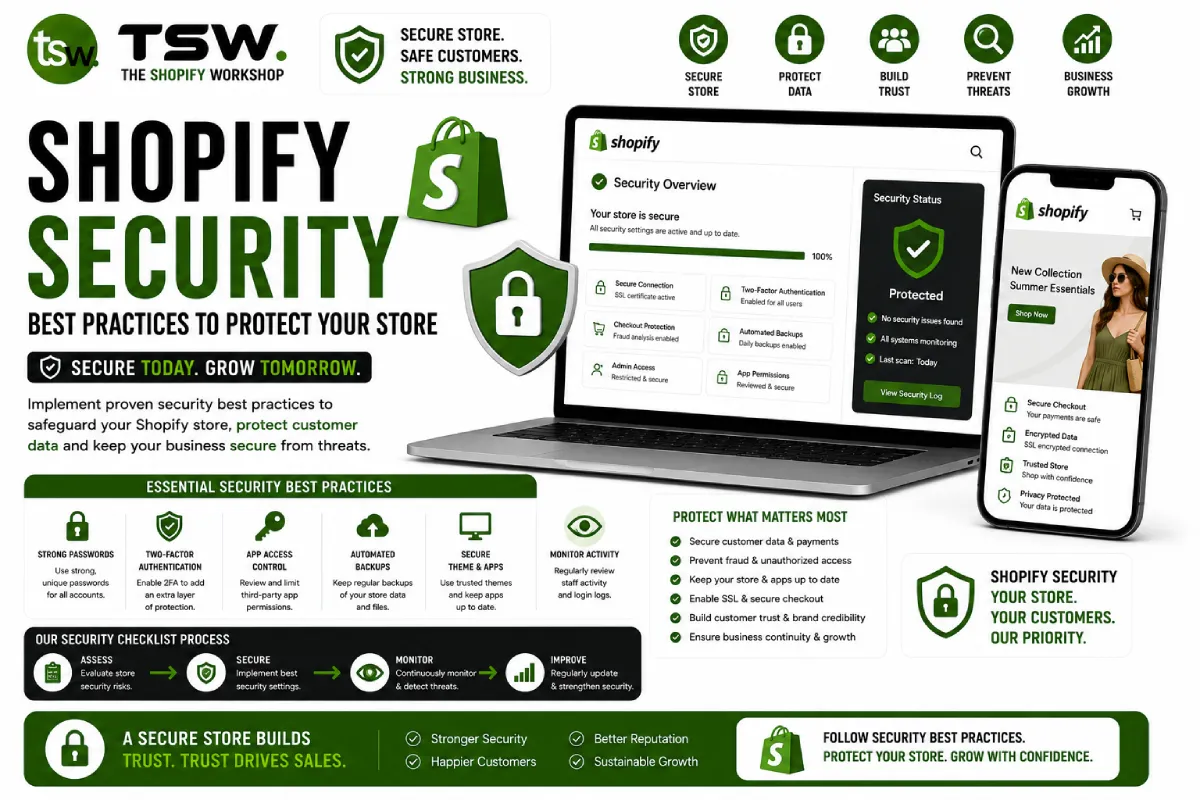
Security Is a Business Imperative
A single security breach can destroy customer trust and cost thousands in chargebacks, fines, and lost revenue. Shopify handles much of the heavy lifting — PCI compliance, SSL, and infrastructure security — but store owners still have responsibilities. Our consultancy includes security auditing as part of store assessments.
What Shopify Handles
Platform Security
Shopify provides PCI DSS Level 1 compliance, SSL certificates for all stores, DDoS protection, automatic security updates, and secure payment processing. This eliminates the infrastructure security burden that self-hosted platforms like WooCommerce require.
Payment Security
Shopify Payments processes card data in Shopify’s PCI-compliant environment. Your theme never touches raw card numbers. Even with third-party gateways, payment forms are hosted externally to maintain compliance.
Your Security Responsibilities
Account Security
- Two-factor authentication: Enable 2FA for all staff accounts — no exceptions
- Strong passwords: Unique, complex passwords for every account
- Staff permissions: Grant minimum necessary access per role
- Regular audits: Remove access for departed staff immediately
- API key management: Rotate keys regularly, never expose in client-side code
App Security
Every Shopify app you install gets API access to your store data. Only install apps from trusted developers with good reviews. Regularly audit installed apps and remove unused ones. Check what permissions each app requests before installation.
Theme Security
Custom themes should never store sensitive data in client-side JavaScript, expose API keys in source code, or include vulnerable third-party scripts. Our development team follows security best practices in every theme build.
Fraud Prevention
Shopify Fraud Analysis
Shopify provides built-in fraud analysis for every order, assigning risk levels based on IP geolocation, AVS matching, shipping/billing address comparison, and historical patterns. Review medium and high-risk orders before fulfilling.
Additional Fraud Protection
Consider Shopify Protect (automatic chargeback protection) or third-party solutions like Signifyd or NoFraud. These use machine learning to identify fraudulent orders with higher accuracy than manual review.
Manual Review Checklist
- Billing and shipping addresses in different countries
- Multiple failed payment attempts before success
- Unusually large first-time orders
- Rush shipping on expensive items
- Free email addresses with mismatched names
Data Protection and GDPR
GDPR Compliance
If you serve EU customers, comply with GDPR requirements: obtain explicit consent for data collection, provide data access and deletion mechanisms, document your data processing activities, and appoint a data protection officer if required.
Cookie Consent
Implement a proper cookie consent banner that blocks tracking cookies until consent is given. Shopify’s Customer Privacy API helps manage consent. Ensure your analytics, advertising pixels, and third-party scripts respect consent choices.
Incident Response
Have a plan for security incidents: identify the breach, contain the damage, notify affected customers, report to relevant authorities (ICO in the UK), and implement preventive measures. Speed and transparency in response minimise long-term damage.
Need a security review? Request a store security audit from our team.